
Bathroom Accessories Mounting Vienna
- Towel rail installation
- Toilet roll holder fitting
- Shower shelf and caddy mounting
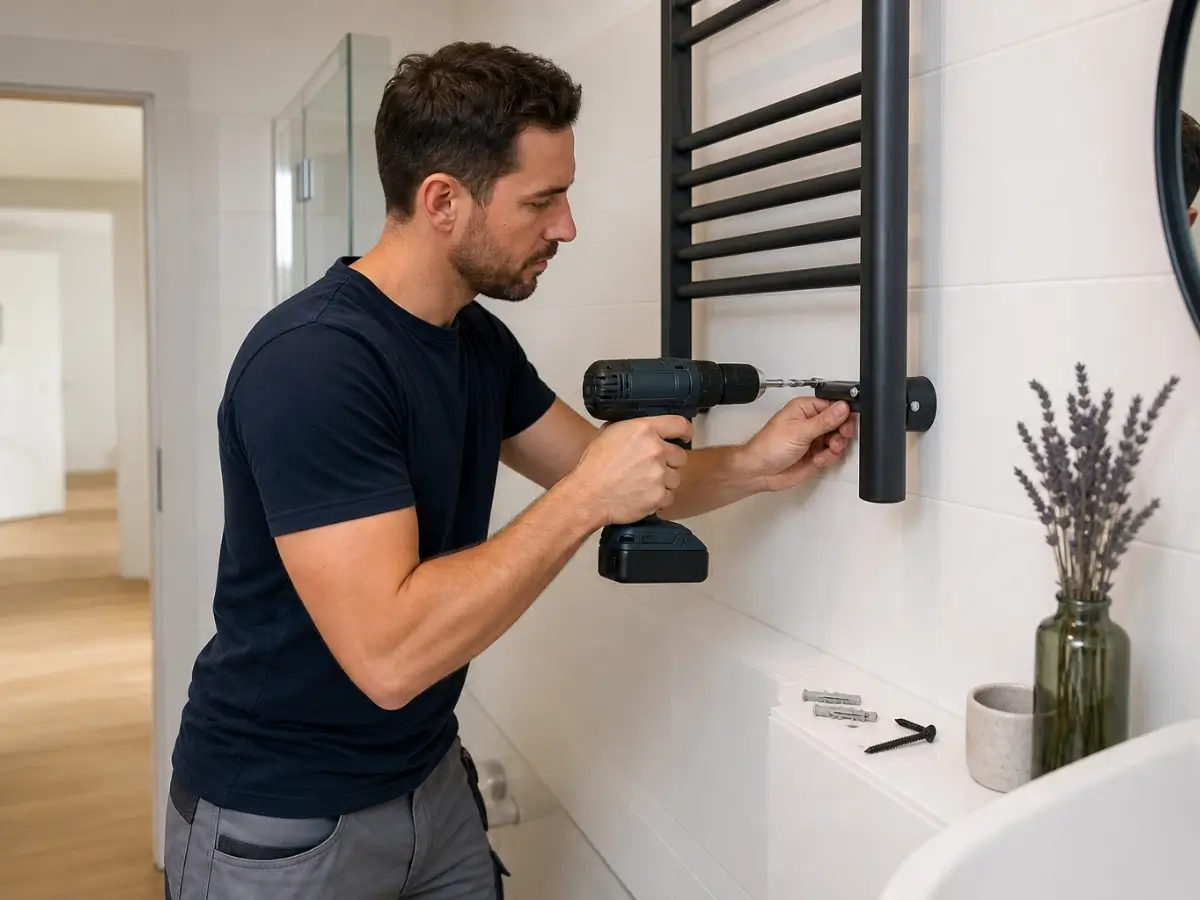

Nick replies personally, usually within the hour.
- 5.0 on Googlefrom 30 reviews
- Price clear upfrontno surprises on the invoice
- All of Viennaall 23 districts plus 50 km around
- Fast replyusually within the hour
What's included
- Diamond bit without hammer actionthe tile is ground, not shattered.
- Stainless steel screws instead of zinc-plated onesno rust on your tiles.
- Anchors matched to the wall behind the tilebrick, concrete or drywall.
- Several items in one visit3 to 5 accessories from €79.
Pricing Overview
Indicative prices. We confirm the fixed price after a description or photo.
- Single accessoryfrom €35
- Combination visit 3-5 itemsfrom €79
- Heated towel rail (fitting only)from €45
Your exact price, before we start
Tell us briefly about the job, with a model name or photo if you like. Fixed price (recommended) or hourly rate, your choice.
Prefer hourly? €60 for the first hour (incl. travel), €50 for each additional hour.
Minimum order value: €60 per visitDetails in the terms
How It Works
- 1
Enquiry
Tell us which items need mounting. A photo helps. You get the price upfront.
- 2
Installation
Check the substrate, agree the height, drill with the diamond bit, mount everything level and firm.
- 3
Done
Fit checked together, drill dust and chips vacuumed, bathroom left clean.
We mount bathroom accessories in Vienna: towel rails, toilet roll holders, soap dispensers, shower shelves, bathroom hooks and toilet brush holders. On tiles, natural stone and drywall. One item from €35, 3 to 5 items in one visit from €79.
In a bathroom, three things come together: hard tiles, moisture and a wall whose build-up you can't see from outside. If a holder pulls out, the tile is usually ruined too. That's why we drill with the right tool and choose the anchor only once we know what's behind the tile.
Drilling Tiles Without Cracking Them
We drill tiles with a diamond bit and no hammer action, with light pressure and cooling. Only once the tile is through do we switch to the right bit for the wall behind. Old Altbau tiles sometimes have fine cracks that are hard to see. There we work especially slowly.
The Right Anchor Behind the Tile
In a Gründerzeit building, behind the tiles there is usually brick with plaster. Newer bathrooms often have concrete or a drywall of gypsum or cement board. A plastic plug made for solid material doesn't hold in a cavity. It gives way as soon as someone pulls the towel off firmly.
We tap the wall, use the scanner and read the drill dust to see what the wall is made of. Then we choose the anchor.
Several Accessories in One Visit
Towel rail, roll holder, hooks and shower shelf are best done together. For 3 to 5 items you pay a package price from €79. You buy the accessories, we bring anchors, screws and tools.
Drilling Tiles: Why the Tool Decides
A tile is hard but brittle. A normal masonry bit with hammer action sends shocks into the glaze. That creates fine cracks that can suddenly run across the whole tile.
A diamond bit grinds through the material without impact. Cooled, the spot stays cold and the tile isn't put under stress. That way even very hard porcelain stoneware can be drilled safely.
Keep a few spare tiles when you have a bathroom tiled. Older tile ranges often can't be bought again.
What Holds Long-Term in a Damp Bathroom
In a bathroom, heat and moisture change all the time. Zinc-plated screws, often supplied with accessories, can rust over time. The brown stain under the holder then comes from the screw, not the accessory.
We use stainless steel screws and plastic anchors that don't rust. In the shower, we seal the holes with silicone so no water runs behind the tile.
If a screw is already rusting, swap it for stainless steel (A2) before the stain soaks into the grout.
Technical Background
What Is Behind the Tile
We establish the substrate before choosing the anchor: tapping, scanner and drill dust. Red dust means brick, grey means concrete, white means gypsum.
Usual Mounting Heights
We hold the items against the wall before drilling and agree the height with you. Only then do we drill.
Important Safety Notes
Cracked Tiles
A cracked tile can't be repaired, only replaced. If the range is no longer available, that gets difficult. The most common causes are hammer drilling, too high a speed and too much pressure.
Rusting Screws in the Bathroom
Zinc-plated screws can rust in a damp bathroom. That leaves stains on the tiles, and the holder works loose. We use stainless steel screws and seal holes in the shower with silicone.
FAQs
What does bathroom accessories mounting cost in Vienna?
A single accessory from €35. 3 to 5 items in one visit from €79 as a package price. Heated towel rail (fitting only) from €45. We confirm the fixed price after a short description, a photo of the items helps.
Which bathroom accessories do you mount?
Towel rails and towel rings, toilet roll holders, soap dispensers, toothbrush cup holders, shower shelves and caddies, bathroom hooks and toilet brush holders. We mount heated towel rails on the wall, without the electrical connection.
Will the tiles crack when you drill?
With a diamond bit, no hammer action and light pressure, the risk is low, but never quite zero. Old tiles with hairline cracks are more sensitive. If we see a risk beforehand, we tell you. Where it works, we drill into the grout joint instead of the tile.
Do I need to provide the accessories?
Yes, you buy the accessories. We bring anchors matched to your wall, stainless steel screws and the tools.
Do bathroom accessories hold on a drywall?
Yes, with cavity anchors that lock behind the board. For a towel rail that gets pulled a lot, we find the metal studs with the scanner and fix there.
The old towel rail wobbles. Can you fix it?
Yes. We take the rail off, check the wall and fill torn-out holes with injection mortar. Then we set new anchors. Usually the rail stays in the same place.
How long does mounting take?
A single item such as a roll holder or hook takes about 20 to 30 minutes. 4 to 5 items usually 60 to 90 minutes, depending on the wall and the number of holes.
Can you mount a heated towel rail?
Yes, we mount it on the wall: drilling the tiles, fixing, levelling. The electrical connection is done by an external licensed electrician.
Service Area
We mount bathroom accessories across Vienna. Gründerzeit buildings in Wieden, Josefstadt, Alsergrund, Meidling or Rudolfsheim-Fünfhaus often still have old tiles that need extra care when drilling.
- 1040 Wieden
- 1080 Josefstadt
- 1090 Alsergrund
- 1120 Meidling
- 1150 Rudolfsheim-Fünfhaus
More services
Tell us what needs doing.
Furniture, kitchen, walls or a list of small jobs: a short message is enough, we'll sort out the rest.