You have a new shelf. The holes are drilled, the plugs are in, the screws are tight. Everything looks good.
Two weeks later, the shelf is leaning forward a little. One screw turns without gripping.
This happens a lot. And usually it's not your fault. It's the wall plug. It doesn't suit the wall.
A wall plug is a small piece of plastic or metal that sits in the drilled hole. When you turn the screw in, it presses against the wall. That's what holds it. But it only works if the wall behind it is solid. Or if the plug is made for exactly that kind of wall.
So the rule is simple: know your wall first, then buy the plug.
Step 1: What is your wall made of?
Three simple tests will tell you.
- Knock. Does the wall sound hollow? Then it's almost certainly a board with empty space behind it.
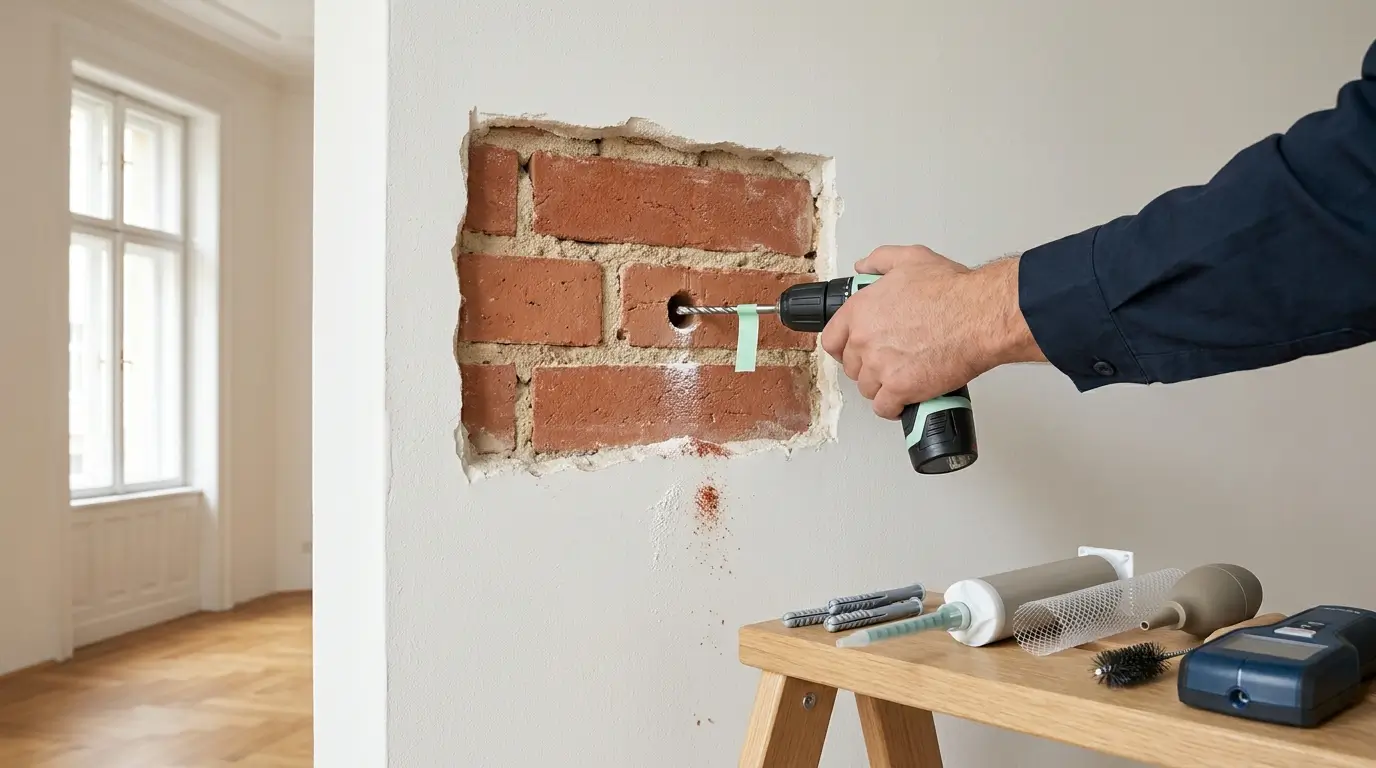
- Drill a test hole. A small hole somewhere that will be covered later. Look at the colour of the dust.
- Feel. How easily does the drill go in? Does it suddenly drop into empty space?
Use this table to match the result:
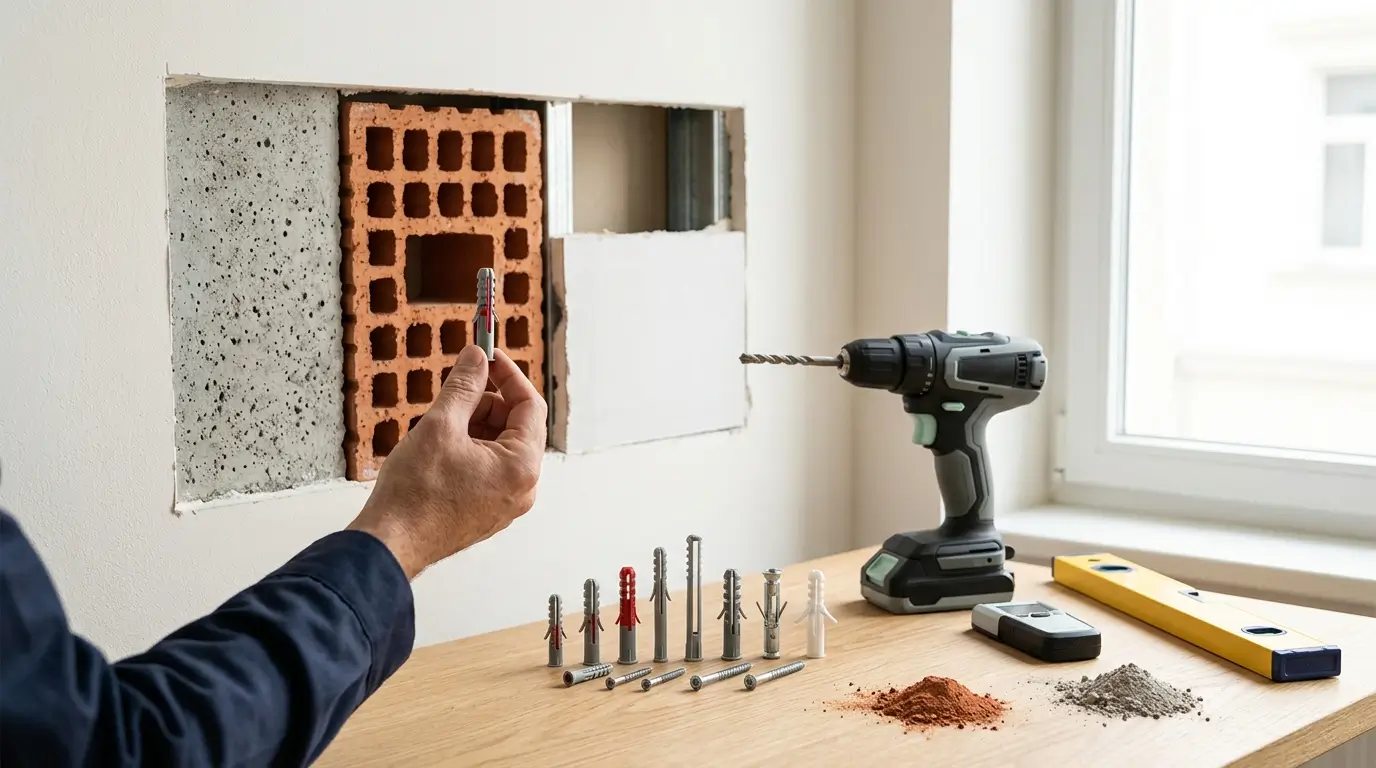
| How it feels | Dust | Your wall |
|---|---|---|
| Very hard, slow going | grey | Concrete |
| Steady, not too hard | red | Brick (solid brick) |
| The drill keeps dropping into empty space | red | Brick with hollow chambers (perforated brick) |
| Hard and steady | white to light grey | Sand-lime brick (pale blocks made of lime and sand) |
| Very easy, almost like wood | white and very fine | Aerated concrete (known as Ytong) |
| Sounds hollow, through after a few millimetres | white | Plasterboard (known as Rigips) |
Step 2: Check for cables before you drill
Before the real hole, one more important step. There can be electrical cables and water pipes inside the wall.
In newer flats they usually run straight up, down or sideways from sockets, switches and taps. In an Altbau (an old building) it can be very different. Cables often run diagonally or in places you wouldn't expect.
A small detector shows where metal and live cables are in the wall. We use one before every hole. For home use, a simple model like the Bosch Truvo* is enough. It costs less than drilling into a cable.
Step 3: Choose the right wall plug
Now you know what your wall is made of. The rest is easy.
First, a word about hammer drilling. That's the drill setting where it hammers as well as turns. It helps in hard walls. In soft walls and walls with hollow chambers it makes the hole too big. Then no plug will hold.
| Your wall | Hammer drilling? | This plug fits | For heavy things |
|---|---|---|---|
| Concrete | yes | Universal plug, e.g. fischer DuoPower* | longer, thicker plugs* |
| Solid brick | only if it won't go in otherwise | Universal plug* | longer plugs* |
| Perforated brick | no | long plugs* | mortar from a cartridge (injection mortar) with mesh sleeves* |
| Sand-lime brick | yes | Universal plug* | longer, thicker plugs* |
| Aerated concrete | no | special aerated concrete plugs* | mortar from a cartridge* |
| Plasterboard | no | cavity anchor, e.g. fischer DuoTec* | screw into the studs behind the board |
Three walls need a bit more explanation.
Plasterboard is only just over a centimetre thick. Behind it there's usually empty space. A normal plug has nothing to press against. A cavity anchor spreads open behind the board and grips it from behind. That's enough for pictures and light shelves. For a bookshelf or a mirror, use a metal cavity anchor* instead. And a wall cabinet or TV shouldn't hang on the board alone. It needs to go into the wooden or metal studs (the frame) behind it.
Perforated brick is built like a honeycomb inside. A short plug ends up in a hollow chamber and barely holds. Use long plugs that reach through several chambers. And drill without hammering, or the thin walls inside the brick break away. If you use injection mortar here, put a mesh sleeve in the hole first. Otherwise the mortar just runs into the hollow chambers.
Aerated concrete is so soft that normal plugs find little grip. There are special plugs with wide ribs for it. Here too: drill without hammering.
Step 4: Choose the right screw for the plug
The right plug is only half the job. It holds only if the drill bit and the screw fit it too.
Plugs and screws are both labelled with two numbers. A 6 x 30 plug is 6 mm thick and 30 mm long. A 5 x 40 screw is 5 mm thick and 40 mm long.
Drill bit and screw thickness
| Plug | Drill bit | Screw thickness | Good for |
|---|---|---|---|
| 5 x 25 | 5 mm | 3 to 4 mm | small pictures, hooks |
| 6 x 30 | 6 mm | 4 to 5 mm | pictures, light shelves, curtain rails |
| 8 x 40 | 8 mm | 4.5 to 6 mm | shelves, mirrors, bathroom cabinets |
| 10 x 50 | 10 mm | 6 to 8 mm | heavy shelves, TV wall mounts |
These are typical values for universal plugs like the fischer DuoPower. The exact range is printed on every pack. As a rule of thumb: the screw is about 2 mm thinner than the plug.
If the screw is too thin, the plug doesn't open up and turns in the hole. If it is too thick, it barely goes in and can crack the plug or the wall.
Screw length
Screw length = plug length + thickness of what you're hanging + one screw thickness.
The extra bit at the end makes the screw tip come out of the plug at the back. Only then does the plug open up along its full length.
An example: you mount a shelf bracket made of 3 mm steel with a 6 x 30 plug and a 5 mm screw. 30 + 3 + 5 = 38 mm. So you take a 5 x 40 screw.
If there's thick plaster on the wall, add its thickness too. More on that in the next section.
The right kind of screw
- Chipboard screws (wood screws with a coarse thread) are right for plastic plugs. A small assortment box* covers most jobs.
- Black drywall screws don't belong in a plug. They are brittle and can snap under load.
- Metal cavity anchors come with their own screw. Use that one.
The hole
- The drill bit is as thick as the plug.
- The hole is about one centimetre deeper than the plug is long. That leaves room for the dust and the screw tip.
- Vacuum the dust out of the hole after drilling. Dust in the hole is one of the most common reasons a plug doesn't hold properly.
In an Altbau: watch out for the plaster
Many old Viennese flats have thick brick walls. That sounds like a perfect hold. But in front of the brick there's often a thick, soft layer of plaster. If the plug only sits in the plaster, it holds almost nothing.
So in an Altbau, use a longer plug. It has to sit firmly in the brick, not just in the plaster. The screw gets longer by the plaster thickness too. If the plaster crumbles a lot, mortar from a cartridge is the better choice. How to measure the plaster and what really holds in old walls is explained in our article Drilling in old buildings.
Do it yourself or call a pro?
Honestly: most people can manage pictures, hooks and small shelves themselves. With the right plug and a little patience, it takes 10 to 20 minutes each.
It's different for anything heavy or hanging above people's heads:
- kitchen wall cabinets
- washbasins
- large TVs
- heavy mirrors
That's about safety. And often about tricky walls like plasterboard, perforated brick or old plaster.
Do you live in Vienna? Then we're happy to do it for you. We check the wall before every hole and bring the right material. Find out more about our wall mounting in Vienna.
What to keep at home
For most jobs, a small basic kit is enough:
- a cable detector, e.g. the Bosch Truvo*
- a box of universal plugs for concrete, brick and light things on plasterboard, e.g. the fischer DuoPower assortment*
- a few cavity anchors for plasterboard, e.g. fischer DuoTec*
- a box of chipboard screws in 4, 5 and 6 mm, e.g. a screw assortment*
- a spirit level, so everything hangs straight in the end
Frequently asked questions
Which drill bit goes with which wall plug?
The drill bit is as thick as the plug. A 6 mm plug needs a 6 mm bit, an 8 mm plug an 8 mm bit.
How long does the screw need to be?
Plug length plus the thickness of what you're hanging plus one screw thickness. Example: 6 x 30 plug, 3 mm bracket, 5 mm screw: 30 + 3 + 5 = 38 mm, so a 5 x 40 screw. If the screw is too short, the plug doesn't open up fully.
How thick does the screw need to be?
About 2 mm thinner than the plug. A 6 mm plug takes a 4 to 5 mm screw, an 8 mm plug a 4.5 to 6 mm screw. The exact range is printed on the plug pack.
Is there one wall plug for every wall?
Almost. Universal plugs hold in concrete, brick and sand-lime brick, and for light things in plasterboard too. For perforated brick, aerated concrete and heavy things on plasterboard there are better options.
The plug keeps turning in the hole. What now?
The hole is too big or the wall is crumbling. Use a thicker plug with the matching bit. If the wall crumbles, mortar from a cartridge (injection mortar) helps.
In short
- Identify the wall first: knock, drill a test hole, look at the dust.
- Check for cables before every hole.
- Concrete, brick and sand-lime brick: universal plugs.
- Perforated brick and aerated concrete: long or special plugs, drill without hammering.
- Plasterboard: cavity anchors. Heavy things go into the studs behind it.
- Screw: about 2 mm thinner than the plug, and as long as plug + part + one screw thickness.