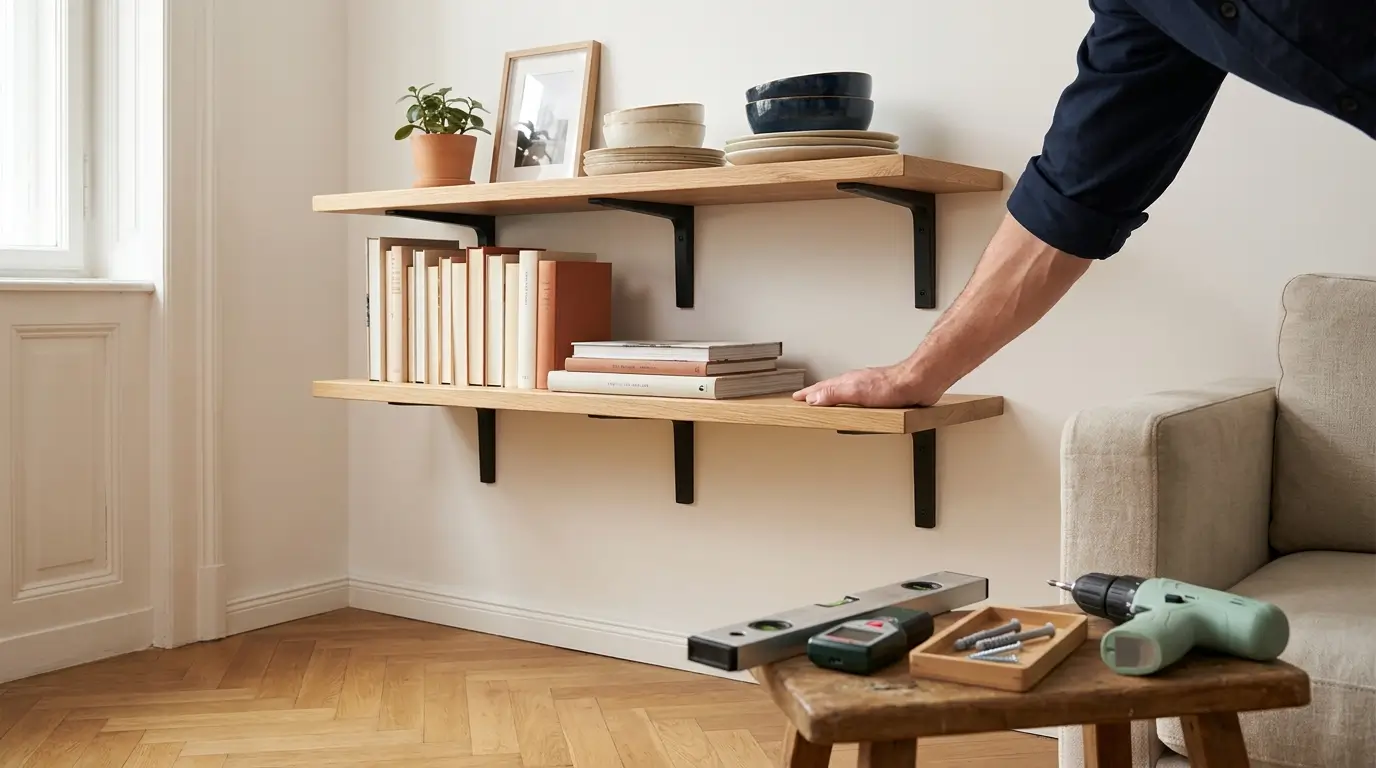
The shelf is drilled, plugged and screwed on. It sits nicely. Then you put the books on it.
The next morning one corner has dropped two centimetres. The screw turns, and the plug turns with it. White dust is crumbling out of the wall around the hole.
It's rarely your fault. The same plug would have held in any newer flat. An Altbau wall (the wall of an old, pre-war building) is simply built differently.
The good news: three rules make it hold. Drill a test hole first, drill without hammer action, and use a plug that's long enough. Below we show why, and how, step by step. We drill into old Viennese walls every week, so this is how we do it on the job.
Why won't the wall plug hold in an old building?
Mostly because it's in the plaster, not the brick. The two other common reasons: it's sitting in a joint (the soft mortar between two bricks), or the hole broke out while drilling and is now too big.
A wall plug holds because it presses against the wall as the screw goes in. For that it needs solid material all around. Old lime plaster is soft. When the plug presses against it, the plaster gives way or crumbles. Then everything turns.
How is a wall in an old Viennese building built?
From the room inwards: a thick layer of lime plaster, then solid brick with joints of lime mortar. That's the typical picture in Gründerzeit buildings, which covers most buildings put up in Vienna between roughly 1850 and 1914.
| Layer | Typical in a Viennese Altbau | What it means for drilling |
|---|---|---|
| Lime plaster | usually 2 to 4 cm, up to 8 cm where the wall is uneven. Soft, white to light grey dust | Holds almost nothing. The plug has to get past it. |
| Mortar joints | Lime mortar, soft and sandy | If the plug lands in a joint, it holds badly. |
| Solid brick | Old, flat bricks, fairly soft. Red dust | Holds well if the whole plug sits in it. |
| Cavities | Sometimes behind the plaster, often at patched spots | The drill drops into empty space for a moment. |
Two special cases on top. Partition walls are often thinner, sometimes only as thick as a brick standing on its edge, plus plaster on both sides. Don't drill too deep there, or you'll come out in the next room. And ceilings in many old buildings are made of timber, more on that below.
Because the old bricks are flat, there's a horizontal joint every few centimetres. The chance of hitting one is high. That's not bad luck, it's how the wall was built.
How do I find out how thick the plaster is?
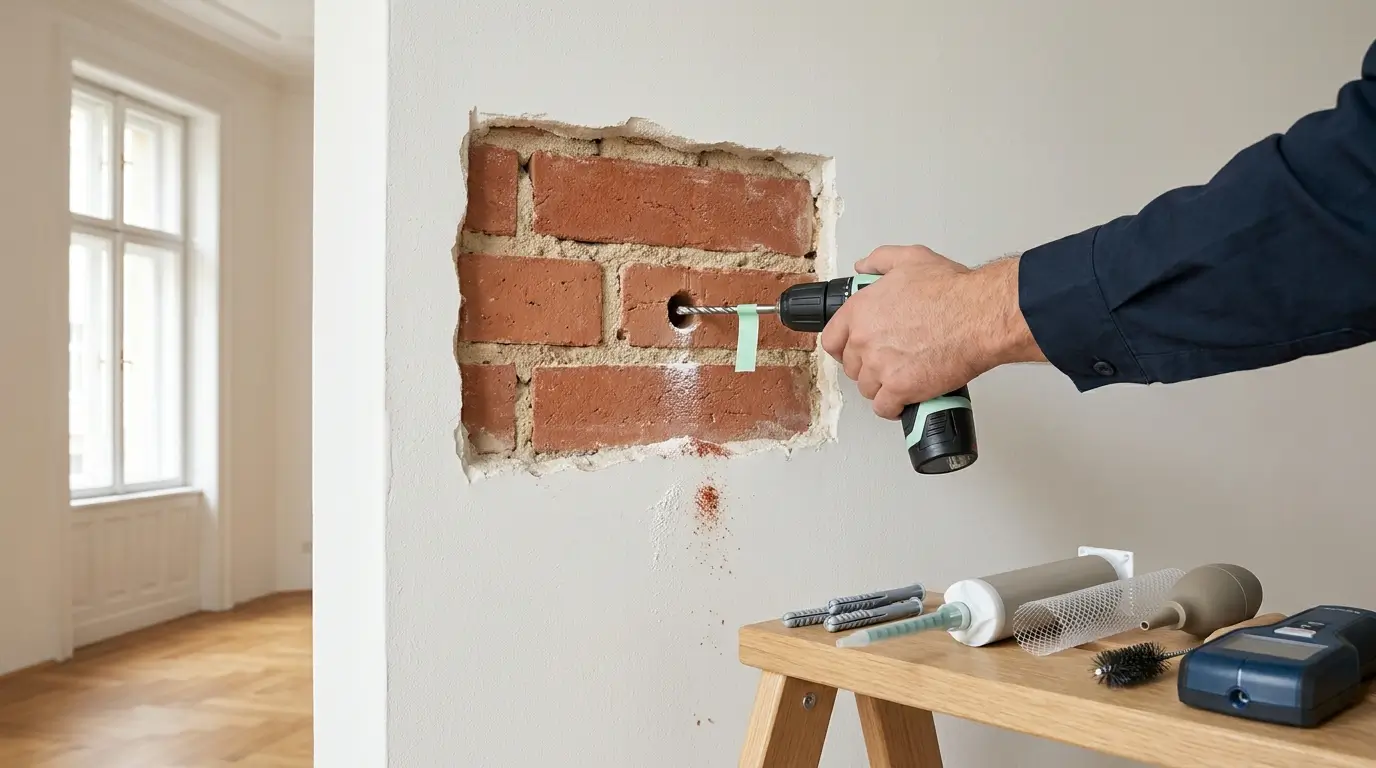
With a test hole. Drill where you plan to hang something, using a 6 mm masonry bit without hammer action, and watch the dust. While it's white or light grey, you're in the plaster. When it turns red, you've reached the brick.
To measure it exactly:
- Stick a piece of tape on the drill bit as a marker.
- Drill slowly. Stop when the dust turns red.
- Slide the tape up against the wall and pull the bit out. The distance from the tip to the tape is your plaster thickness.
Now you know how long the plug needs to be. More on that in a moment.
The test hole tells you something else, too. If the dust never turns red and the drill goes in very easily, you may be in a joint or an old patch. Move the hole two or three centimetres up or down.
Hammer drilling or not?
Never through the plaster, and usually not in the brick either. The old bricks are soft enough that a sharp masonry bit gets through without hammer action.
Hammer drilling means the drill turns and hammers at the same time. In concrete that's right. In an old building the hammer knocks away the soft plaster and the brick edges at the front of the hole. The hole becomes funnel-shaped and too big. That's exactly when the plug starts turning later on.
In old buildings we almost always drill without hammer action and with little pressure. If a spot really won't give, we switch the hammer on briefly, only once the bit is already deep in the brick.
Which wall plug holds in an old building?
One that's long enough to sit firmly in the brick. For heavy things or crumbly walls, mortar from a cartridge (injection mortar) is the safest choice.
The rule of thumb: the plug has to sit in the brick, not the plaster. It only holds where it widens and presses tight as the screw goes in. With 3 cm of plaster, a 5 cm plug only has 2 cm in the brick. That's enough for a picture, not for a shelf. With 6 to 8 cm of plaster, even a long plug barely reaches the brick. Then only injection mortar with a long anchor helps, or a different spot.
That's why we often set the plug deliberately deeper. Here's how:
- Drill the hole one centimetre deeper than usual.
- Push the plug in with a nail or screwdriver until it sits one centimetre below the wall surface.
- Use a screw that's one centimetre longer than usual.
Now the plug widens in the brick, and the plaster at the front stays intact.
| What you're hanging | What holds in an old building |
|---|---|
| Pictures, hooks, light decor | Universal plug, e.g. fischer DuoPower 6 x 30*, set a little deeper |
| Shelves, mirrors, coat racks | Long plugs, e.g. fischer DuoPower 10 x 80*, with a long screw |
| Wall cabinets, TVs, washbasins, towel radiators | Injection mortar* with a threaded rod or internal-thread anchor |
| Anything at crumbly or patched spots | Injection mortar, with a mesh sleeve in cavities |
Two words from the table explained. A threaded rod is a metal rod with a thread, onto which you later screw a nut. An internal-thread anchor is a metal sleeve with a thread inside, so a normal screw fits into it.
A mesh sleeve is a small tube of plastic mesh. It goes into the hole, the mortar is pressed into it and squeezes through the mesh into the cavities. That way it doesn't disappear uselessly into the wall.
How to identify other walls (concrete, perforated brick, plasterboard) is explained in our article Which wall plug for which wall?.
How do I use injection mortar properly?
Drill, clean the hole thoroughly, fill the mortar from the back to the front, insert the threaded rod or anchor, let it cure. It sounds like more work than it is. Each hole takes a few minutes, plus the waiting time.
- Drill. Diameter and depth are on the cartridge or the anchor packaging.
- Clean. Blow out, brush out, blow out again. Dust in the hole is the most common mistake. The mortar then sticks to the dust instead of the brick.
- Squeeze out the first bit. The cartridge has two chambers that only mix in the long tip (the mixing nozzle). Squeeze the first mortar into a cup until it's an even colour. Only then is it mixed properly.
- Fill. Push the mixing nozzle to the bottom of the hole and pull it out slowly while filling. That avoids air pockets. Fill the hole about two-thirds.
- Insert. Push in the threaded rod or anchor with a slight twist. A little mortar should come out at the front.
- Wait. The curing time is on the cartridge and depends on temperature. In a cold flat it takes longer. Don't load it until then.
Most cartridges of this kind fit a standard silicone gun. Check the label before you buy.
What can be hidden inside an old wall?
Electrical cables in unexpected places, gas pipes and chimney flues. Old buildings have been altered over decades. What's true in a new flat (cables run straight from sockets and switches) isn't true here.
- Old electrical cables often run diagonally or across the wall, sometimes just below the plaster. A detector like the Bosch Truvo* belongs in front of every hole. We scan every spot, even when it looks harmless.
- Gas pipes are present in many Viennese flats with a gas boiler or gas cooker. Around the boiler, cooker and meter, only drill if you know where the pipe runs.
- Chimney flues often run through the interior walls of Gründerzeit buildings. If a wall is noticeably thick or warm, or a boiler is connected to it, don't drill deep there. A hole into a flue in use can let exhaust gases into the flat. If in doubt, ask the building management or the chimney sweep.
What about the ceiling? This is where it gets dangerous
On an old ceiling, a plug in the plaster holds nothing, and often neither does a hook or a screw. Only what sits in a timber beam holds safely. A lamp falling from the ceiling isn't a cosmetic problem. It can hurt someone.
Many old buildings have a timber beam ceiling (Tramdecke in Vienna): wooden beams, boards below them, then reed matting and plaster. The plaster on the ceiling is often even thicker than on the walls. And the boards are old and not always firmly attached. A screw that only sits in plaster and boards can work loose over time.
- Every lamp, even a light one, belongs in a beam. Find it with test holes using a thin bit until you hit solid wood. Beam spacing isn't standardised, so measure rather than guess.
- No beam at that spot? Then there's often no safe fixing there. We tell our clients that honestly, instead of hanging something that only holds in plaster. Usually the solution is to move the lamp a little, to where a beam is.
- Stucco: don't drill into it. It's often made of plaster and breaks easily. Place the lamp or track next to it.
If you're not sure your ceiling will hold, don't hang anything. That's exactly the case for a pro.
The hole has torn out. What now?
Fill it with injection mortar and set the plug or threaded rod straight into it. A torn-out hole in an old building is rarely a disaster. With mortar it often holds better than before.
Here's how:
- Pull out the old plug and remove loose crumbs with a screwdriver.
- Blow out and brush the hole, as described above.
- Fill it with injection mortar. If the hole is very large, use a mesh sleeve.
- Insert the anchor or threaded rod and let it cure.
What doesn't hold: plaster, filler or wooden sticks in the hole. Plaster is good for closing an old hole invisibly. For new grip it's too soft. A thicker plug in the same hole also only helps briefly in crumbly plaster.
If the spot is completely ruined, drill a new hole three or four centimetres away. Many brackets have several holes for exactly this reason.
DIY or hire a pro?
Pictures, hooks and small shelves you can do yourself in an old building, with a test hole, a long plug and no hammer action. Allow 15 to 30 minutes per item, test hole included.
Leave these to a pro:
- kitchen wall cabinets and heavy shelves with dishes or books
- TVs, especially on swivel arms
- washbasins and towel radiators
- anything on the ceiling, lamps included
- drilling close to a gas pipe, boiler or chimney flue
This is about a lot of weight and about safety. A wall cabinet full of dishes doesn't just pull down. It also tips forward, and that leverage pulls the top screws right out of the wall.
Do you live in Vienna? Then we're happy to take care of it. We check every spot with a detector, measure the plaster and use injection mortar in old walls where needed. Find out more about our wall mounting in Vienna. For lamps on old ceilings, see our light installation in Vienna.
What you need for an old building
- a cable detector, e.g. the Bosch Truvo*
- sharp masonry bits in 6, 8 and 10 mm
- long wall plugs, e.g. fischer DuoPower 10 x 80*, with screws long enough to match
- injection mortar such as fischer FIS V 360 S*, plus mesh sleeves* and a blow-out pump with brush
- tape to mark the plaster depth on the drill bit
Frequently asked questions
Why does the wall plug keep turning in an old building?
Usually it's sitting only in the soft lime plaster or in a mortar joint, where it has nothing to grip. A longer plug that sits firmly in the brick, or mortar from a cartridge (injection mortar), solves it.
How thick is the plaster in an old building?
In Vienna's Gründerzeit buildings usually 2 to 4 centimetres, up to 8 centimetres where the wall is uneven. On the ceiling often even more. You can measure it with a test hole: as soon as the dust turns red, you're in the brick.
Should I use hammer drilling in an old building?
Never through the plaster. The old bricks usually drill well without hammer action too. With hammer action the hole breaks out easily and ends up too big.
Can I repair a wall plug hole that has torn out?
Yes. Clean the hole, fill it with injection mortar and set the plug or threaded rod straight into it. After the curing time shown on the cartridge, it often holds better than before. Filler or plaster only closes the hole, it gives no new grip.
Will a wall plug hold in an old ceiling?
No. Ceiling plaster in old buildings is often very thick and holds neither plugs nor hooks. Only a screw in the timber beam above holds safely. If there's no beam where you want to hang something, there's often no safe fixing at that spot, not even for a light lamp.
In short
- In old buildings, the plug usually fails because it's in the plaster instead of the brick.
- Drill a test hole: when the dust turns red, you're in the brick. That's your plaster thickness.
- Drill without hammer action, use long plugs and set them one centimetre deeper.
- For heavy things and crumbly spots: injection mortar. On the ceiling: only into a timber beam, otherwise not at all.
- Check for cables before every hole. Take care near gas pipes, boilers and chimney flues.