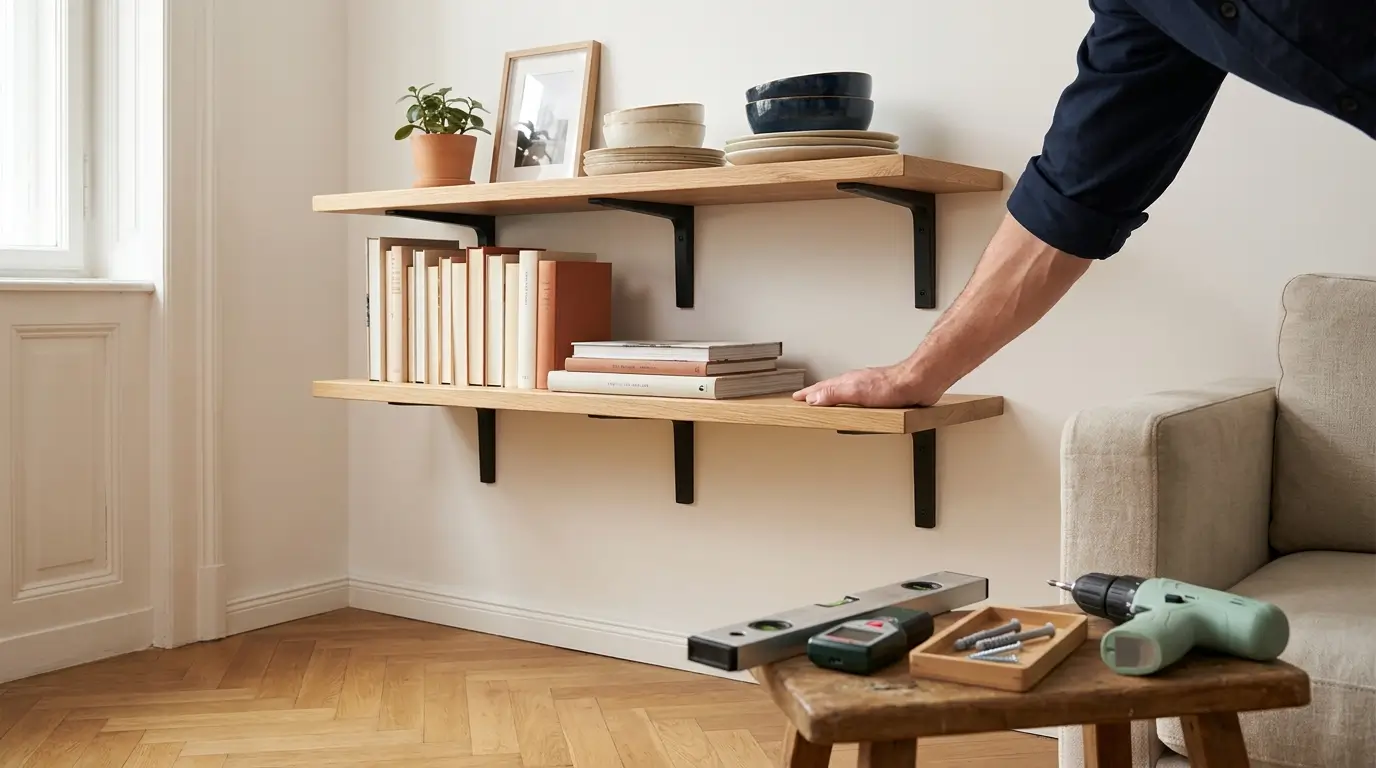
The new shelf is up. Straight, clean, levelled with a spirit level. You fill it with books, row by row.
Three weeks later you notice it from the side: the front edge sits a few millimetres lower than the back. Above the bracket, a fine crack has appeared in the wall.
Not bad luck. The shelf simply carried more than its fixing could take. And the weight wasn't even the biggest problem. The problem was leverage.
How much your shelf holds comes down to four things: wall, plug, bracket and board. The weakest one decides. We go through all four. With real values from the manufacturer and what we see when mounting shelves in Vienna apartments.
How heavy will your shelf be?
Heavier than most people think. Books and dishes most of all. And the shelf itself weighs something too.
The easiest way: weigh instead of guessing.
- Step on the bathroom scale and note your weight.
- Put everything that's going on the shelf in a box and step on the scale again holding the box.
- The difference is your load. Add the shelf board itself, usually printed on the packaging.
As a rough guide:
| What goes on the shelf | How heavy it gets |
|---|---|
| Decor, plants, a few picture frames | light, usually under 10 kg |
| Paperbacks, one metre | quickly 15 to 20 kg |
| Art books, binders, records, one metre | 25 kg and more |
| Plates and bowls in the kitchen | heavy, and they get jostled every time you take one out |
Plan with a margin. Shelves rarely end up emptier than planned.
What does a wall plug really hold?
That depends almost entirely on the wall. The same plug carries more than five times as much in concrete as in plasterboard. Here are the values from fischer's load table for the DuoPower universal plug, per single plug:
| Plug | Concrete | Solid brick | Plasterboard 12.5 mm |
|---|---|---|---|
| DuoPower 6 x 30* | about 80 kg | about 40 kg | about 12 kg |
| DuoPower 8 x 40* | about 90 kg | about 45 kg | about 15 kg |
| DuoPower 10 x 50* | about 200 kg | about 100 kg | about 15 kg |
fischer gives the values in kilonewtons. 1 kN is about 100 kg. These are recommended loads, so the safety margin is already included.
Sounds like a lot? The numbers only apply when everything is right: the right screw, a clean hole, a solid wall. And the load has to pull straight down. On a shelf it doesn't. More on that in a moment.
Three walls are missing from the table on purpose:
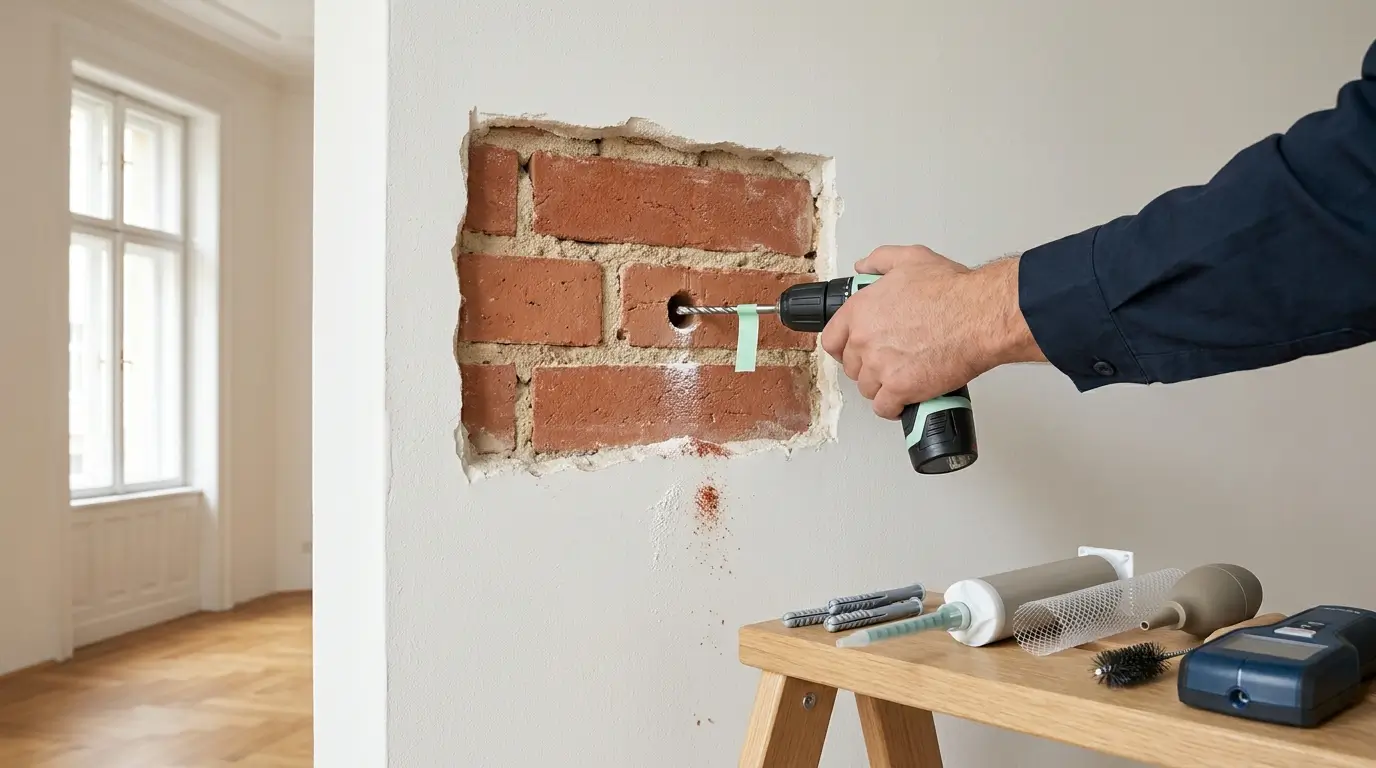
- Old buildings: the solid-brick value only applies if the plug sits fully in the brick, not in the plaster. In Vienna's Gründerzeit buildings there's often 2 to 4 cm of soft plaster in front. How to measure it is in our article on drilling in old buildings.
- Perforated bricks (bricks with many hollow chambers inside): long plugs or injection mortar from a cartridge with a mesh sleeve.
- Aerated concrete (known as Ytong): only special aerated-concrete plugs.
Which plug suits which wall and how long the screw has to be is explained in detail in Which wall plug for which wall?.
Why does a shelf tear out of the wall at the top?
Because of leverage. The load on the shelf doesn't just push down. It tries to tip the shelf forward. The shelf pivots around the bottom edge of its mount, and the top screws get pulled out of the wall.
How hard they pull depends on two measurements:
- How deep the shelf is. The further forward the load sits, the bigger the lever.
- How tall the mount is on the wall. The further apart the top and bottom fixings are, the better the pull is spread.
An example, simplified: 20 kg on a 25 cm deep shelf. With a shelf bracket 15 cm tall, the top screw pulls with about 17 kg. With a floating mount only 5 cm tall, it's about 50 kg. Same weight, three times the pull.
So a plug rated at 40 kg quickly reaches its limit on a full shelf. That's also where the fine crack above the mount comes from, the one we see so often. That's exactly where the screw pulls on the wall.
Brackets or a floating shelf?
Brackets for heavy things. Floating is fine for decor and light items. On a floating shelf the mount is hidden inside the board. It looks calmer, but the lever is the shortest. Such a shelf forgives very little.
| Shelf brackets | Floating shelf | |
|---|---|---|
| Typical load | often 30 to 50 kg per pair in a solid wall | usually 10 to 30 kg per pair (manufacturer data), IKEA LACK 5 to 15 kg |
| Lever at the wall | long, spreads the pull well | short, the top screw pulls hard |
| For books and dishes | yes | only with a steel mount in concrete or solid brick |
| On plasterboard | yes, screwed into the studs | light decor only |
| On an uneven wall | very forgiving | the board visibly tips forward |
| Look | visible | calm, nothing to see |
Want a floating shelf to carry books after all? Then use a steel mount with long rods* that reach almost the full depth of the board. The board needs to be at least 4 to 5 cm thick for that. The mount goes into a solid wall with several long plugs. In old buildings, with injection mortar.
For brackets: use steel brackets* whose arm under the board is almost as long as the shelf is deep. A 20 cm bracket under a 30 cm deep board leaves 10 cm free at the front. That's exactly where the lever is biggest.
What does a shelf hold on plasterboard?
Not much, as long as it hangs on the board alone. According to fischer, a good metal cavity anchor* holds up to 20 kg in 12.5 mm plasterboard, a plastic plug much less. Not enough for a bookshelf.
Here's how it holds anyway:
- Find the studs. Behind the board there are metal or timber studs, usually 62.5 cm apart. A detector like the Bosch Truvo* shows them. Without one: probe with a thin drill bit in a spot that will be covered until you hit metal or wood.
- Screw into the studs. Into timber with long wood screws, into metal with sheet-metal screws or a metal cavity anchor* right next to the stud.
- The shelf doesn't line up with the studs? Screw a batten or rail across two studs and hang the shelf on that.
Light shelves with decor can go between the studs, with metal cavity anchors, at least two per mount. Double-boarded walls (two boards on top of each other, common in bathrooms and between apartments) hold a lot more than a single board.
How far apart can the brackets be?
As a guide, no more than 80 cm for a 25 mm board. That's what a shelf-bracket manufacturer recommends. For thinner boards and books, we move the brackets closer, to 50 to 60 cm.
The reason: the board can sag even when the plugs hold. Chipboard (the usual furniture board made of pressed wood chips) slowly gives way under a constant load. Solid wood and plywood stay stiffer.
Keep the overhang at the ends to 10 to 15 cm. Otherwise a heavy stack at the very edge acts as a lever too.
Hanging a wall shelf step by step
- Know the load. What's going on it? Weigh it if you're not sure.
- Check the wall. Knock, drill a test hole, look at the dust. In old buildings, measure the plaster depth.
- Look for cables. Before every hole, with a detector.
- Choose the mount. For heavy things, brackets with a long arm, no more than 50 to 80 cm apart.
- Mark it out. Draw a line with a spirit level* and mark every hole.
- Drill and plug. The drill bit is as thick as the plug. Vacuum the hole. Set the plug flush with the wall, a little deeper in old buildings.
- Screw it on and test. Before you load it: press down firmly on the front edge with both hands. If anything moves, the fixing isn't right.
DIY or call a pro?
A shelf for decor, plants or a few books is a job you can do yourself if you know your wall. Allow 30 to 45 minutes, including marking out.
A pro is worth it for:
- floating shelves for books or dishes
- open kitchen shelves above the worktop
- shelves on plasterboard that need to carry more than decor
- old walls with thick or crumbly plaster
- long shelf walls that need to be dead straight over several metres
We see the same mistakes again and again:
- plastic plugs sitting only in old plaster
- floating shelves full of books on a single mount
- brackets much shorter than the shelf is deep
It holds for a few weeks. Then the shelf tips forward.
Live in Vienna? We'll mount your shelf at a fixed price. We check the wall, scan for cables and choose the fixing for what will really go on it. A photo of the wall and the shelf is enough to ask. More on our shelf mounting in Vienna page.
What you need
- a wall detector, e.g. the Bosch Truvo*
- plugs that suit the wall, e.g. fischer DuoPower 8 x 40* for brick and concrete, metal cavity anchors* for plasterboard
- chipboard screws in the right length, e.g. a screw assortment*
- steel shelf brackets with a long arm, e.g. 250 mm steel brackets*
- a spirit level, 60 cm or longer
Frequently asked questions
How much weight can a wall shelf hold?
As much as its weakest part: the wall, the plug, the bracket or the board. On brackets in concrete or solid brick it easily carries 30 to 50 kg. Floating on plasterboard, often only 5 to 10 kg. Depth matters too: the deeper the shelf, the harder it pulls on the top screws.
How much does a wall plug hold?
According to fischer's load table, a DuoPower 8 x 40 holds about 90 kg in concrete, about 45 kg in solid brick and only about 15 kg in 12.5 mm plasterboard. That's for a single plug in a sound wall. In old buildings the value only counts if the plug sits fully in the brick.
How much can a floating shelf hold?
Manufacturers usually state 10 to 30 kg per pair of mounts at 20 to 25 cm depth. IKEA gives 5 to 15 kg for the LACK wall shelf, depending on the wall. For books and dishes, brackets are almost always the better choice.
Can I hang a bookshelf on plasterboard?
Only if it's screwed into the studs behind the board, or if many metal cavity anchors share the load. On the board alone, with plastic plugs, a full bookshelf won't hold for long.
How far apart can shelf brackets be?
As a guide, no more than 80 cm for a 25 mm board. For thinner boards and heavy books, less: around 50 to 60 cm. Otherwise the board sags over time.
In short
- A shelf holds as much as its weakest part: wall, plug, bracket or board.
- Weigh instead of guessing. Books and dishes are heavier than you think.
- The same plug carries more than five times as much in concrete as in plasterboard. In old buildings only what sits in the brick counts.
- Leverage pulls the top screws out of the wall. Floating shelves have the shortest lever. That's why they hold the least.
- For heavy loads: steel brackets with a long arm, 50 to 80 cm apart, and into the studs on plasterboard.