The new curtains have arrived. Heavy fabric, floor length, exactly the right colour. Then you're standing in the DIY store in front of a wall of rods, tracks, brackets and rings. And nobody tells you which of them suits your window.
The short answer: a track is a tool, a rod is a piece of furniture. You barely see a track, it carries a lot and runs quietly. You do see a rod, it's part of the room. Which one suits you comes down to three questions. How heavy is the fabric? How wide is the window? And should it go on the wall or the ceiling?
We hang curtains in Vienna every week, often in period apartments with three-metre windows. Here's how we decide.
What's the difference between a curtain track and a curtain rod?
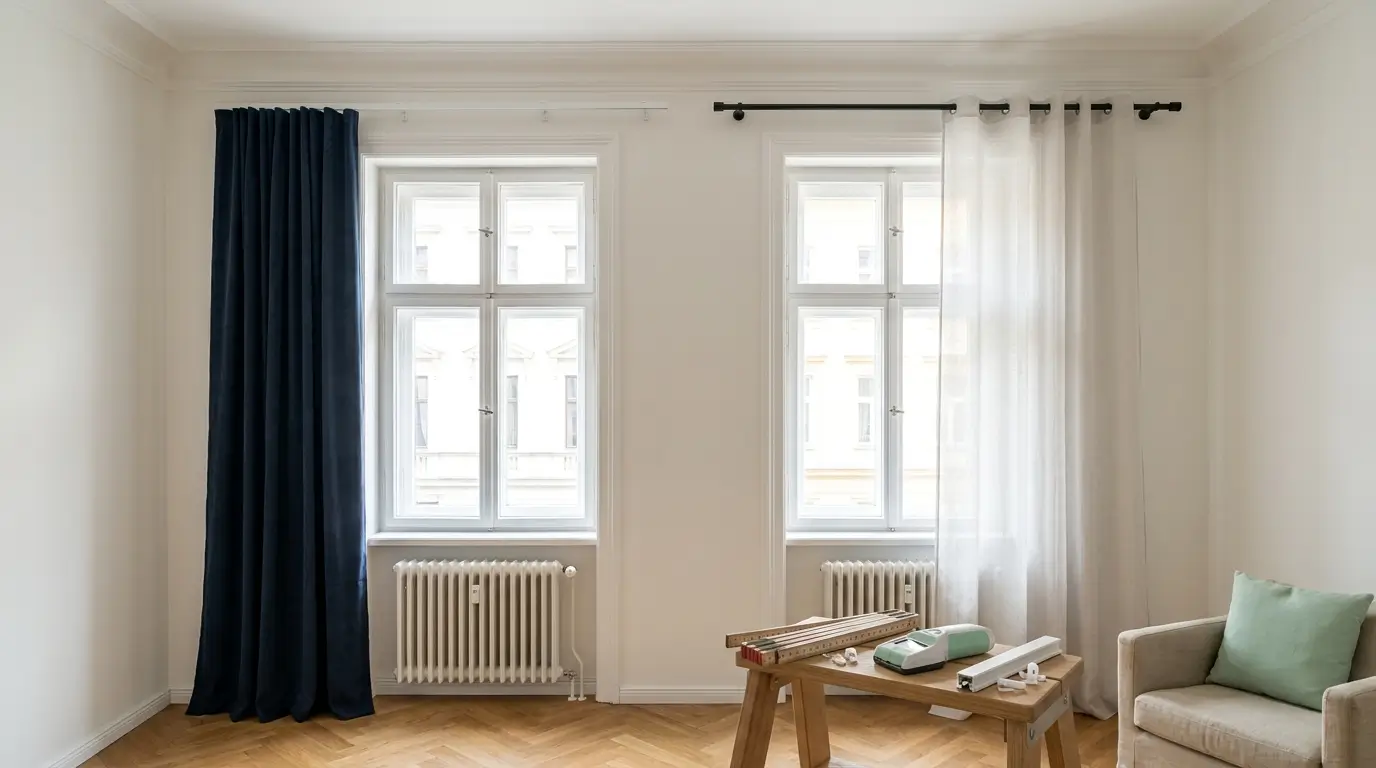
A curtain rod is a tube on two or three brackets. The curtain hangs from it on rings, eyelets or tabs. A curtain track is a flat profile, usually aluminium, with small gliders running inside it. The curtain hangs from the gliders.
Almost everything else follows from that:
| Curtain rod | Curtain track | |
|---|---|---|
| Look | visible, decorative | almost invisible, especially on the ceiling |
| Mounting | on the wall, standing off from it | on the ceiling or on the wall |
| Running | rings and eyelets catch a little | gliders run easily and quietly |
| Light at the top | gap above the rod | no gap when ceiling-mounted |
| Length | fine up to about 2.5 m, harder beyond | 4 m and more, even around corners |
| Several layers | double rod possible | double track for sheer and curtain |
| Changing curtains | easy, slide the eyelet curtain off | unhook from the gliders |
Which option suits your window?
Start with the room, not the product. This is how we decide with our clients:
| Situation | Our recommendation |
|---|---|
| Living room, standard window, light to medium fabric | A rod if you want it on show. Otherwise a track. |
| Bedroom that needs to get properly dark | Ceiling track, curtain to the floor |
| Wide window front, or balcony door plus window, over 2.5 m | Track. A rod would need several brackets and still sag. |
| Bay window or corner window | Bendable track or corner connectors |
| Sheer and curtain together | Double track, or a double rod for narrow windows |
| Tall period window, floor-to-ceiling curtain | Track just below the ceiling, see the old-building section below |
| Rented flat, just a light sheer | Tension rod inside the window recess, no drilling |
One thing we often say: if you open and close the curtain every day, you'll be happier with a track. If you mostly leave it open and like the look of the rod, go with a rod.
How wide and how high should the rod or track be?
Add 15 to 20 centimetres per side beyond the window width. Height: at least 10 to 15 centimetres above the window frame, or go straight to just below the ceiling.
The width is about the open curtain. It needs space, and that space should be beside the window, not in front of the glass. A thin sheer needs little. A velvet curtain with plenty of fullness easily stacks 30 to 40 centimetres wide. For heavy fabrics we prefer to add 25 to 30 centimetres per side.
For height: the higher it goes, the taller the room looks. A curtain that starts right under the ceiling and falls to the floor stretches any wall. You just need to buy or alter the curtain to that length. So measure the mounting height first, then buy the fabric.
Leave 1 to 2 centimetres of air at the floor. Then the hem doesn't drag and stays clean.
Is there a radiator under the window? Then a floor-length curtain traps part of the heat behind it in winter. Open it during the day. Or use a blind here for light and privacy, with the curtains only as side panels left and right.
How heavy is your curtain, and what does that mean for the fixings?
Usually between 1 and 6 kilos. Any good fixing can carry that. The real problem is the pulling: every time you open the curtain, you tug the brackets sideways and forwards. That, not the weight, is why brackets work loose after a few months.
Typical fabric weights (rough values, your label gives the exact figure in g/m²):
| Fabric | Weight per m² | Example: period window, 3 m drop, 4 m fabric width |
|---|---|---|
| Sheer, voile | 50 to 120 g | about 1 to 1.5 kg |
| Decorative curtain, linen, cotton | 200 to 300 g | about 2.5 to 3.5 kg |
| Blackout, velvet, thermal curtain | 300 to 500 g | about 3.5 to 6 kg |
The 4 metres of fabric width in the table come from the fullness: for a curtain to hang nicely, the fabric is about twice as wide as the track.
What this means for mounting:
- Rods: 16 mm diameter only for short rods and light sheers. 20 mm is standard. For long rods and heavy fabrics, 25 to 28 mm. From about 2 metres we add a third bracket in the middle, from 1.5 metres for heavy fabrics.
- Tracks: a fixing every 50 to 80 centimetres, and one about 10 centimetres in from each end. For heavy fabrics, closer to every 50 centimetres.
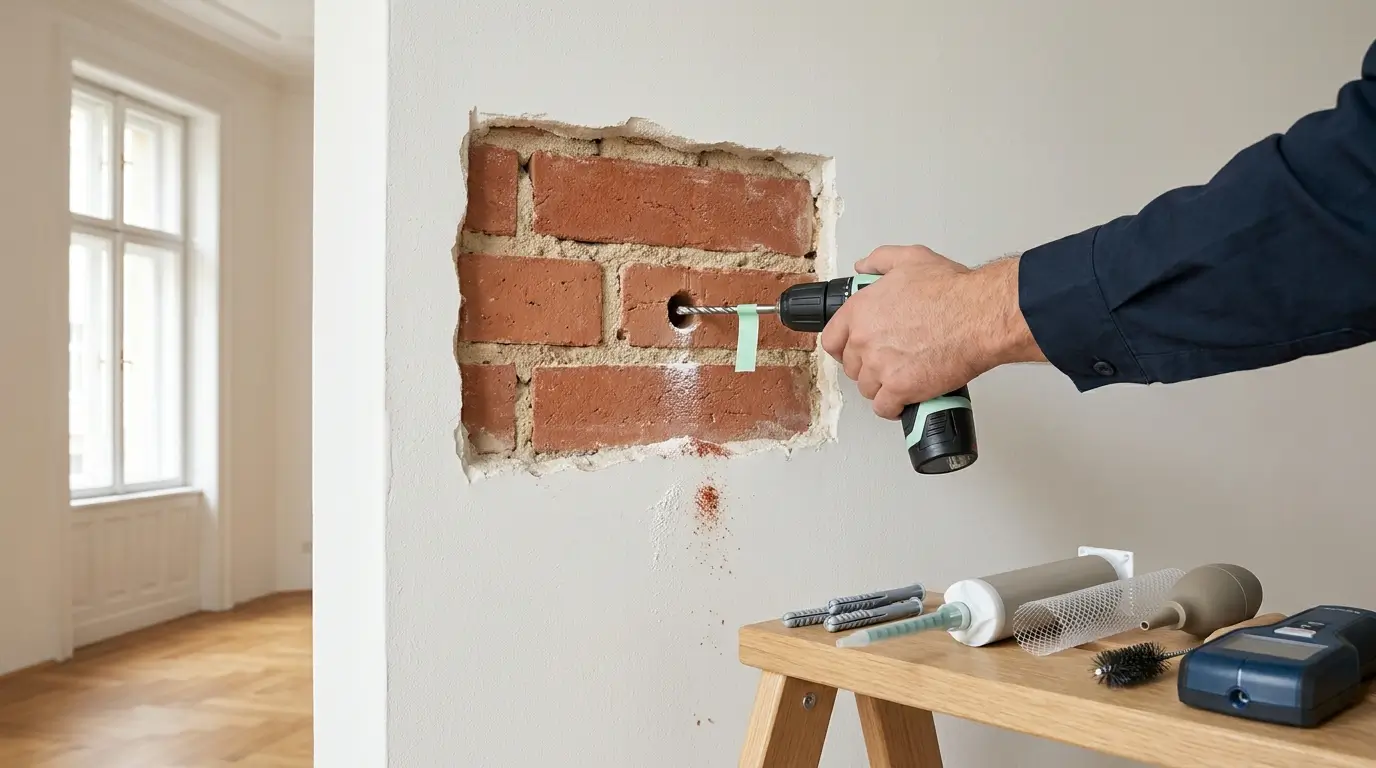
- Wall plugs: chosen for the wall, not the curtain. Which plug goes in which wall is in our guide Which Wall Plug for Which Wall?.
Ceiling or wall: which holds better?
On a concrete ceiling a track holds very well. On a wall, both hold well. It gets tricky with plasterboard ceilings and with timber ceilings in old buildings.
- Concrete ceiling (most buildings from about 1950 on, including Vienna's council housing): track with plugs straight into the ceiling. Scan for cables and rebar (the steel inside the concrete) first. If the drill hits steel, move the hole a few centimetres.
- Plasterboard ceiling (a suspended ceiling of drywall boards): ideally screw into the metal profiles above. In the board alone, with cavity anchors, it holds a light sheer. That's not enough for heavy curtains.
- Wall above the window: there is often a lintel here. That's a beam over the window opening, made of concrete or mixed masonry. The wall is different there from the wall beside it. In newer buildings there may also be a roller shutter box. Drilling into the box is expensive to fix. That's why we always scan above the window first.
Tall period windows in Vienna: what do you need to watch out for?
Four things: the timber beam ceiling, the stucco, the casements of the box windows and the top window. These are where we most often rethink the plan in Viennese period apartments.
The ceiling. In most Gründerzeit buildings (the typical Viennese period buildings from around 1850 to 1914), the ceiling is a Tramdecke: timber beams, with boards, reed matting and thick plaster underneath. Nothing holds in that plaster, not even a light track. It has to go into the beams. The problem: if the beams run parallel to the window wall, the track often doesn't hit a single one. Then the track goes on the wall, just below the ceiling. It sits on wall brackets, small angles that hold it out from the wall. From below it looks almost the same. There's more on old ceilings in our article Drilling in Old Buildings: Why the Wall Plug Won't Hold.
The stucco. Many period rooms have a stucco cornice where the wall meets the ceiling. A track can't sit flush in that corner. We place it in front of the cornice on wall brackets with the right projection, or just below it. We don't drill into the stucco itself. It's often made of gypsum and breaks easily.
The box windows. Vienna's typical box windows (Kastenfenster) have two layers of windows, and the inner casements open into the room. If the open curtain hangs in front of the reveal (the deep window recess), the casements swing into the fabric. So the track needs to be wider here, so the open curtain sits fully beside the recess.
The top window. Many tall period windows have a top light that tilts inwards. If the rod hangs too low or too close to the wall, it hits it. Open it fully once before drilling and measure how far it reaches into the room.
And because period windows are often 2.5 metres tall or more: a floor-to-ceiling curtain for a 3.2 metre ceiling is a length you won't find off the shelf. Plan for made-to-measure or alterations.
A blind instead of a curtain? With or without drilling?
A roller blind or pleated blind sits right in or on the window and takes up little space. It doesn't always replace the curtain, but it often works well alongside it: the blind for privacy by day, the curtain for a cosy evening.
- Roller blind: fabric that rolls up at the top. With side guides (rails left and right) it gets almost completely dark. Good for bedrooms.
- Pleated blind: folded fabric, tensioned at the top and bottom. It opens from the top and from the bottom. Handy on the ground floor: closed at the bottom for privacy, open at the top for light.
- No drilling (clamp fitting): the brackets clamp onto the window casement. That works well on modern uPVC windows. On old timber windows, the gap between casement and frame is often too tight. Then the window won't close properly with the clamps on. On painted wood, clamps also leave marks over time.
- Drilled: two small screws into the timber frame or plugs into the reveal. It lasts, and for blackout blinds with side guides it's the only good option.
With box windows there's also a Viennese option: the blind between the two window layers, mounted at the top of the box. From inside you hardly see it. It only works if there's enough room in the box and no casement hits it. You can then only operate it with the inner casement open.
Do it yourself or call a pro?
A curtain rod on a normal wall is a job you can do yourself. The first time, allow about an hour per window, including measuring, scanning and levelling.
Jobs for a pro:
- tracks on an old timber ceiling or below stucco
- windows over 2.5 metres tall (you need a safe ladder and a second pair of hands)
- tracks over 3 metres or around corners
- plasterboard ceilings with heavy curtains
- several windows on one wall that all need to hang at exactly the same height
With that last one, every mistake shows. Two rods 5 millimetres apart will catch your eye every evening. So we level all the windows in a room in one go with a laser. Only then do we drill the first hole.
Live in Vienna? We're happy to take it on, including several windows in one visit, rod, track and blind together. A photo of the windows is enough for a fixed price. More on our curtain and blind installation in Vienna.
What you need
- a wall scanner, e.g. the Bosch Truvo*, for the area above the window
- a curtain rod with a 20 mm diameter and three brackets, e.g. an extendable 20 mm metal rod*
- or an aluminium curtain track for ceiling or wall, e.g. an inner-glider track*
- for dark bedrooms, a blackout blind with side guides*
- for rented flats with uPVC windows, a clamp-fit pleated blind, no drilling*
- wall plugs to suit the wall, and a folding rule or tape measure
Frequently asked questions
Which is better, a curtain track or a curtain rod?
For floor-to-ceiling, heavy or blackout curtains, the track is better. It runs more quietly, lets no light in at the top and can go on the ceiling. A rod is better when you want it to be seen and the window is no wider than about 2.5 metres.
How far should a curtain rod extend past the window?
15 to 20 centimetres on each side, more for thick fabrics. That way the open curtain sits beside the window, not in front of the glass.
How high above the window should a curtain rod go?
At least 10 to 15 centimetres above the window frame. If you want the room to feel taller, mount the rod or track just below the ceiling. In old buildings with box windows, check first whether the top window hits it when it opens.
When does a curtain rod need a centre bracket?
We add a third bracket in the middle from about 2 metres, and from 1.5 metres for heavy fabrics. Without it the rod sags over time and the rings stop running smoothly.
Can I screw a curtain track to the ceiling in an old building?
Only into the timber beams, not into the plaster. If the beams run parallel to the window wall, the track often doesn't hit a single one. In that case we mount the track on the wall just below the ceiling, using wall brackets.
In short
- A track for heavy, floor-to-ceiling and blackout curtains. A rod when you want it on show and the window isn't too wide.
- 15 to 20 cm per side beyond the window, more for heavy fabrics. At least 10 to 15 cm above the frame, or just below the ceiling.
- Rods from about 2 m need a centre bracket. Fix tracks every 50 to 80 cm.
- In old buildings: track only into the ceiling beams, otherwise on the wall. Check stucco, box windows and the top window first.
- Above the window, always scan for cables and a roller shutter box first.