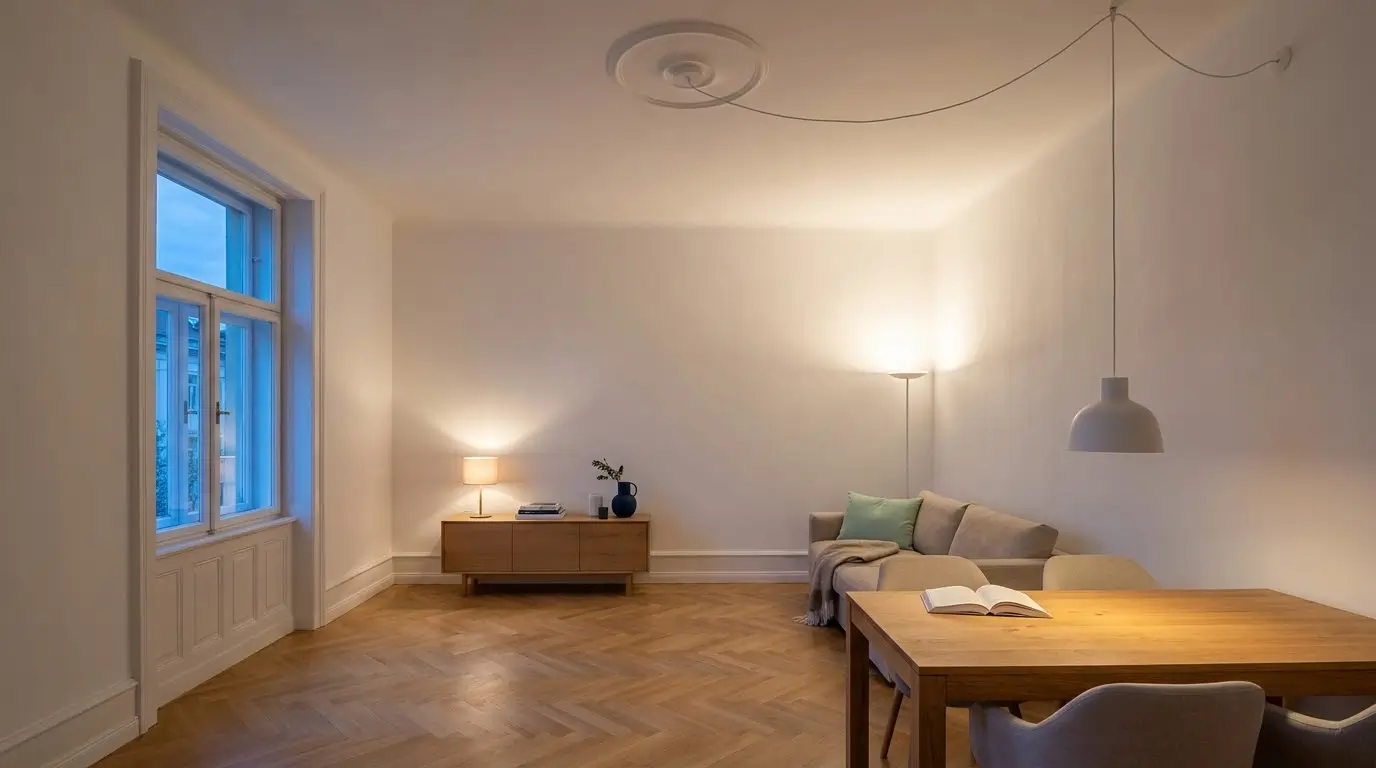
The move is done. The furniture is in place, the pictures are up. And in the living room, a single bare bulb dangles from two wires in the ceiling.
So a nice ceiling light goes up. A big one, so it's bright enough. On the first evening it really is bright. But it isn't cosy. The room feels like a waiting room: harsh light from above, dark corners, shadows on everyone's face.
That isn't the lamp's fault. It's because one lamp is almost never enough.
Good lighting isn't a question of budget. It's a question of planning, and that's simpler than it sounds. We'll go room by room: which lamp goes where, how bright it should be and which light colour fits. With numbers you'll find printed right on the box when you buy.
Why one ceiling light isn't enough
A room needs light from several sources. Lighting designers talk about three layers:
- Ambient light: so you can move around safely and find things. Usually the ceiling light.
- Task light: bright, focused light where you do something. Above the worktop, at the desk, at the mirror, next to the reading chair.
- Mood light: soft, warm light for the evening. A floor lamp in the corner, a table lamp on the sideboard, a light strip behind the TV.
Most homes only have the first layer. That's why it's either too harsh or too dark. Once two or three lamps shine at different heights, the same room feels calmer and bigger. In the evening, the ceiling light can even stay off.
The easiest first step: put a floor or table lamp in the darkest corner of the room. No drilling, no electrician, and you'll notice the difference straight away.
How bright? Lumens, not watts
People used to buy bulbs by wattage. With LEDs, watts only tell you how much power a bulb uses, not how bright it is. Brightness is printed on the box in lumens (lm).
For orientation, here's how bright the old incandescent bulbs were:
| Old bulb | Roughly equals |
|---|---|
| 40 watts | 470 lumens |
| 60 watts | 806 lumens |
| 75 watts | 1,055 lumens |
| 100 watts | 1,521 lumens |
How much light a room needs depends on its size. There's no binding standard for homes. But these guide values work well, and they match what we see in apartments:
| Room | Lumens per m² (all lamps together) | Example |
|---|---|---|
| Living room, bedroom | 100 to 150 | 20 m²: 2,000 to 3,000 lm |
| Hallway | around 100 | 8 m²: around 800 lm |
| Kitchen, bathroom | 250 to 300 | 10 m²: 2,500 to 3,000 lm |
| Worktop, desk | around 500 right at the work surface | a dedicated lamp for it |
The figure is for all lamps in the room combined. So a 20 m² living room doesn't need a single ceiling light with 3,000 lumens. A better mix is a ceiling light with 1,500, a floor lamp with 800 and a table lamp with 500 lumens.
Two things swallow light: high ceilings and dark walls. In a Viennese Altbau with 3.20 metre ceilings, add about 10 to 20 percent. And plan a little more light plus a dimmer. You can always dim a bright light, but a dim one won't get brighter.
Which light colour for which room?
Light colour is given in kelvin (K). The lower the number, the warmer and more yellow the light. The higher, the cooler and bluer.
| Light colour | Kelvin | Effect | Good for |
|---|---|---|---|
| Extra warm white | 2,200 to 2,700 K | like candlelight, very cosy | mood light, bedroom in the evening |
| Warm white | 2,700 to 3,000 K | warm, relaxed | living room, dining table, bedroom, hallway |
| Neutral white | 3,500 to 4,000 K | clear, alert | kitchen worktop, bathroom, desk |
| Daylight white | 5,000 K and up | cool, clinical | workshop, basement. Usually too cold for living spaces |
The most common mistake we see in homes: in one room, the ceiling light is cool, the floor lamp warm and the reading lamp somewhere in between. It feels restless, even if you can't say why. Stick to one light colour per room, with no more than 300 to 500 kelvin difference.
Colour rendering: the number almost nobody checks
Good LED boxes show a third value: Ra or CRI. It tells you how natural colours look under the light. Daylight is 100.
- Ra 80: fine for hallways, storage rooms, basements.
- Ra 90 and above: skin, food and clothes look like they do in daylight. Worth it in the kitchen, bathroom, dining area and walk-in wardrobe.
If there's no value on the box, it's usually around 80. LED bulbs with Ra 90 often cost only a little more, for example dimmable E27 bulbs with 2,700 K and Ra 90*.
Room by room: which lamp goes where?
Living room
Here you need all three layers. A ceiling light for ambient light, a floor lamp next to the sofa or reading chair, and one or two small light sources for the evening. A floor lamp that shines upwards (an uplighter) makes the room especially soft, because the light bounces back from the ceiling.
Behind the TV, a light strip helps. It softens the harsh contrast between a bright screen and a dark wall, so your eyes tire less.
Dining table
A dining table needs a pendant light, meaning a lamp that hangs from the ceiling on a cable. It belongs over the centre of the table, not the centre of the room. The bottom of the shade hangs 60 to 70 centimetres above the tabletop. Higher, and it dazzles the people sitting there. Lower, and it gets in the way of conversation.
For a long table, two or three smaller pendants in a row work better than one large one. Warm white, 2,700 to 3,000 K, ideally dimmable.
If the ceiling outlet isn't above the table, there are two options. An electrician moves the outlet. Or the cable is run to a ceiling hook above the table. It looks neat and is very common in Viennese period apartments.
Kitchen
The kitchen is where poor lighting bothers people most. The ceiling light is behind you, so you're chopping in your own shadow.
The fix is light under the wall cabinets. An LED under-cabinet light* or light strip lights the worktop directly from the front and above. Neutral white, 3,000 to 4,000 K, with Ra 90, so vegetables, meat and spices show their real colours. For IKEA kitchens, there are lights made to fit right under the cabinets.
Bedroom
Here, the evening is what counts. A ceiling light for tidying up and getting dressed, plus reading lights by the bed. Wall lights with a switch right at the bed save space on the bedside table.
Warm white, ideally extra warm at 2,200 to 2,700 K for the reading lights. Bright, cool light shortly before sleep wakes you up again.
Bathroom
In the bathroom, two things matter: good light at the mirror and protection from moisture.
Mirror light works best from both sides or all the way around, at face height. A single lamp above the mirror casts shadows under the eyes and chin. Neutral to warm white, 3,000 to 4,000 K, with Ra 90.
Bathroom lights need protection against splashing water. It's shown as IP followed by two digits on the fitting. IP44 is the minimum in a bathroom. Directly above or next to the shower and bathtub, stricter rules apply. They're set out in the electrical standards for wet rooms. Lights in those areas are a job for an electrician.
Hallway
Hallways are often long and narrow, with one light at the entrance. Two or three smaller ceiling lights in a row, or wall lights on both sides, work better. Warm white, on the brighter side, so coming in from outside feels pleasant.
A small trick for the night: a battery or rechargeable motion-sensor light near the floor. No drilling, no cables.
Home office
At your desk you need around 500 lux right on the work surface. That's the figure the European standard for office workstations (EN 12464-1) sets. It applies to a home office too. A ceiling light alone rarely manages it.
Place a good desk lamp on the side opposite your writing hand. For right-handers, that's the left. That way you don't write in your own shadow. Neutral white, 4,000 K, during the day. Make sure the lamp doesn't reflect in your screen.
Period apartments: what's different in Viennese homes
In Viennese Altbau apartments we see the same features again and again. They're not a problem if you know about them in advance.
- One single ceiling outlet, right in the middle. Usually just one per room. If you want more lights, plan floor lamps, table lamps and plug-in wall lights. New outlets mean cutting channels into the ceiling, and an electrician.
- High ceilings, 3 metres and more. A pendant with a short cable then hangs far too high and mostly lights the ceiling. On most pendants, the cable can be lengthened or shortened. Above a dining table, that's almost always needed.
- A stucco rose around the outlet. We drill especially carefully here. A large canopy (the cover at the ceiling) can hide or damage the rose. Small canopies leave the stucco visible.
- Old ceiling hooks in crumbly plaster. A hook that has been in the ceiling for decades looks solid. Often, though, it's only sitting in old plaster. Before a heavy light goes up, we test it and fit a new one if needed.
- Old wiring. Some period buildings still have wiring without an earth (the green-yellow wire) or old aluminium cables. Then an electrician needs to look at it before the new light goes up.
One more point on weight: the brackets that come in the box with many lights are usually rated for only a few kilos. A chandelier or heavy designer light needs a hook that suits the ceiling. How to identify your ceiling or wall is explained in our article Which wall plug for which wall?.
Do it yourself or call a pro?
You can do a lot of this yourself, often in an hour:
- Very easy: floor lamps, table lamps, swapping bulbs, plug-in light strips. No tools needed.
- With some experience: a light ceiling lamp on an existing outlet. Turn the breaker off first. Then check with a voltage tester (a device that shows whether there's power) that the wires are really dead. Only then start.
- Better left to a pro: heavy lights and chandeliers, pendants with the cable run over the table, wall lights with tidy cable routing, anything in an Altbau with stucco or old hooks.
- Electrician only: new cables, new sockets or switches, lights in the bathroom's protected zones, old wiring without an earth.
Do you live in Vienna? Then we're happy to install your lights. We scan the ceiling and wall before every hole, fit hooks rated for the weight and route cables neatly. We do several lights in one visit, at a fixed price. Find out more about our light installation in Vienna.
What you need
- LED bulbs in the right light colour with Ra 90, for example dimmable E27 bulbs with 2,700 K* for living spaces and bedrooms.
- A floor lamp for the darkest corner, ideally an uplighter with a dimmer*.
- Under-cabinet lights for the kitchen, neutral white.
- Smart bulbs, if you want to control brightness and colour by app or switch, for example Philips Hue White Ambiance*. Handy when there's no dimmer in the wall.
- A voltage tester before you work on a ceiling outlet.
- A wire detector like the Bosch Truvo* before you drill for hooks or wall lights.
Frequently asked questions
How many lumens do I need for a living room?
As a rule of thumb, around 100 to 150 lumens per square metre, spread across several lamps. For 20 square metres that's 2,000 to 3,000 lumens. With high ceilings or dark walls, add about 10 to 20 percent.
Warm white or neutral white: which is better?
Warm white (2,700 to 3,000 kelvin) for living rooms, bedrooms and the dining table. Kitchens, bathrooms and desks can be a bit brighter and more neutral (3,000 to 4,000 kelvin). What matters most is that all lamps in one room have roughly the same colour.
How high should a pendant light hang above the dining table?
Around 60 to 70 centimetres between the bottom of the shade and the tabletop. That way it doesn't dazzle anyone and the table is well lit. With high period-apartment ceilings, the cable usually needs extending so the light still hangs at that height.
Can I connect a light fitting myself?
A floor or table lamp with a plug, of course. Many people connect a ceiling light to an existing outlet themselves. Turn the circuit breaker off first and check that there's really no power. New cables, sockets or switches are a job for a licensed electrician in Austria.
What does Ra or CRI on the box mean?
It's the colour rendering index: how natural colours look under the light. Daylight is 100. Good LED bulbs have Ra 90 or more. It's most worth it in the kitchen, bathroom and wardrobe.
In short
- Every room needs several light sources: ambient, task and mood light.
- Plan brightness in lumens: around 100 to 150 lm/m² in living spaces, 250 to 300 in kitchens and bathrooms, more with high ceilings.
- One light colour per room. Warm white for living, neutral white for working.
- Ra 90 for the kitchen, bathroom and dining table.
- Pendants 60 to 70 cm above the table. In an Altbau, adjust the cable and check old hooks.