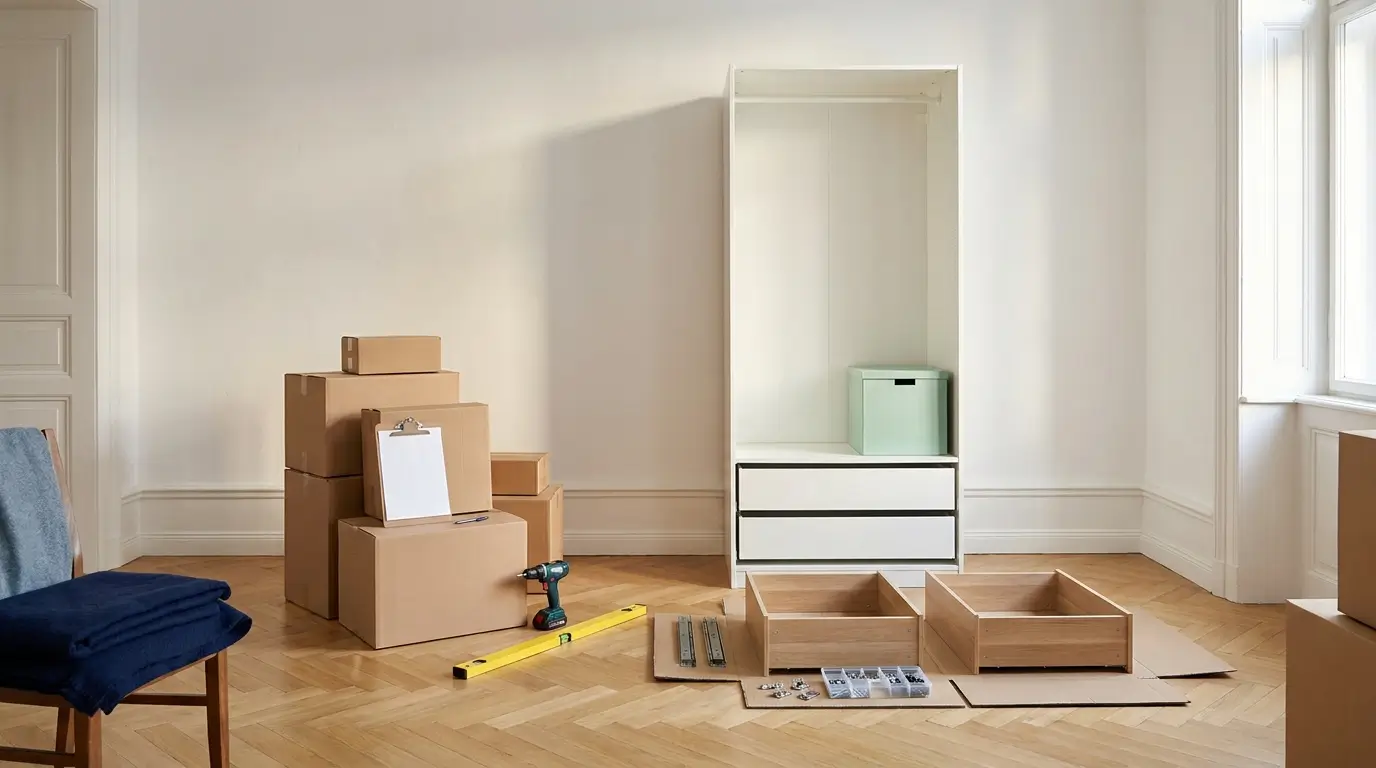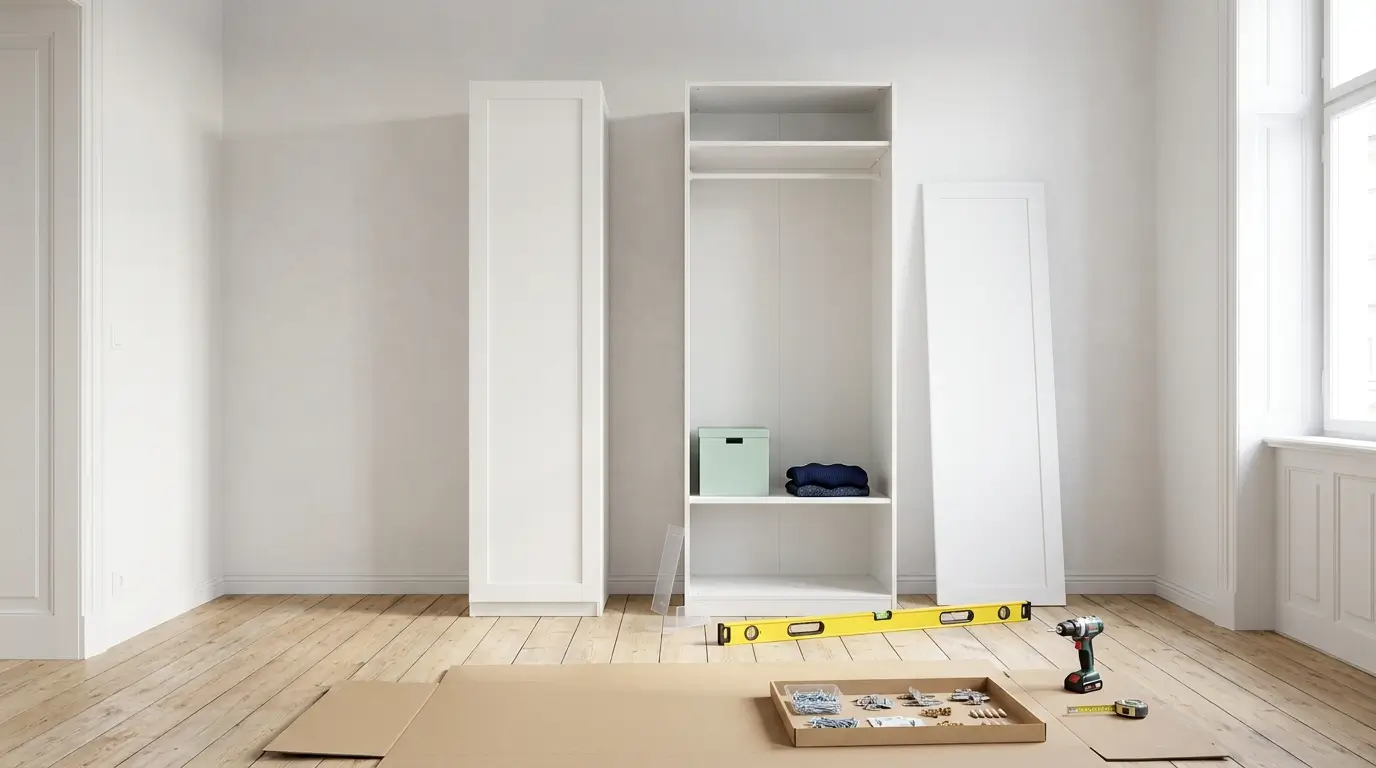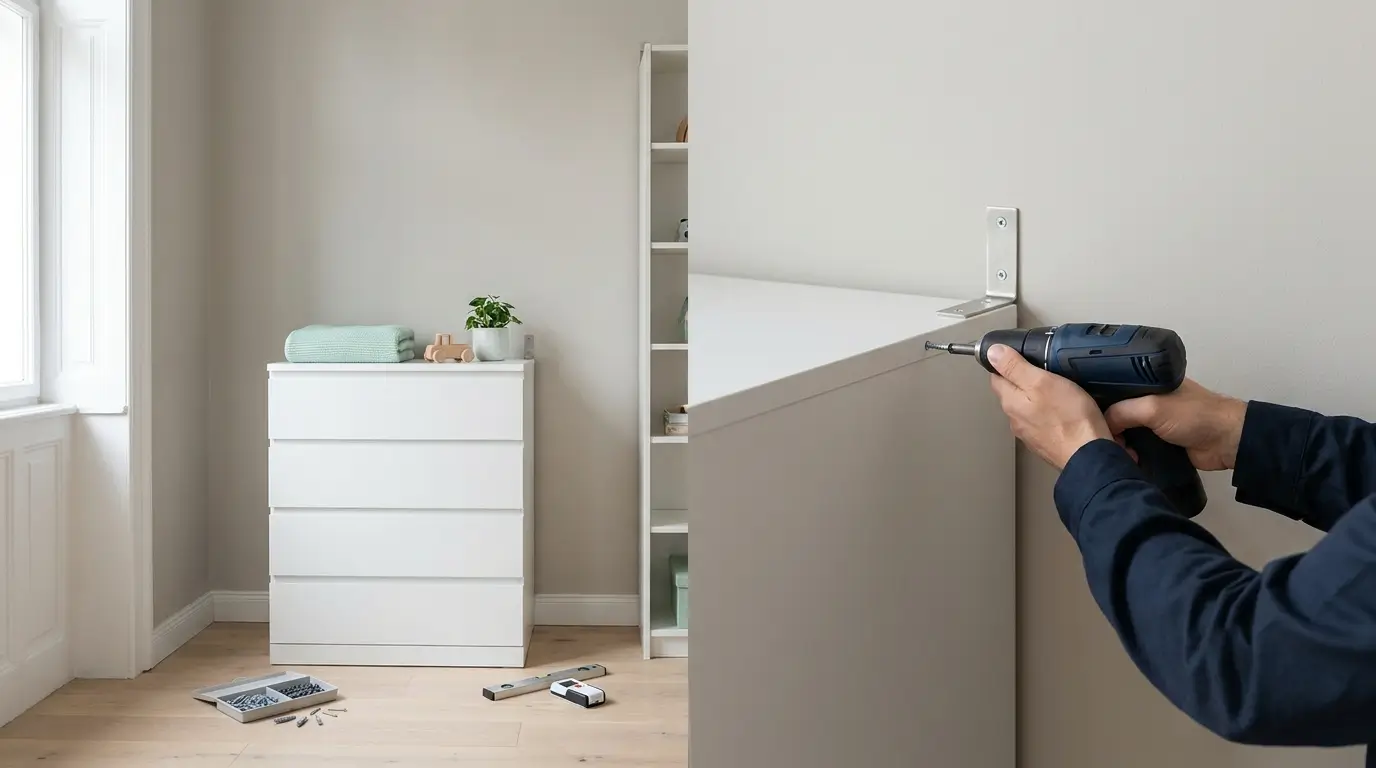
The new chest of drawers stands in the children's room. It's heavy, it looks solid, and the little bag with the anti-tip kit is still in the box. "It's not going anywhere", you think.
It isn't, as long as all the drawers are shut. Pull out two drawers, let a child stand on the bottom one, and it's a different story. The piece tips over its front edge. It happens fast and without warning.
In 2016 IKEA recalled around 29 million chests of drawers in the US and Canada after children died under furniture that had tipped over. Since then almost every tall piece of furniture comes with an anti-tip kit. It still doesn't always get fitted.
With us it's part of every assembly. Here we show which furniture we anchor, how we do it on each type of wall, and how you can tell a fixing that really holds.
Why does furniture tip over at all?
Because the centre of gravity moves forward. A piece stands safely as long as its weight sits behind the front edge. Every open drawer, every heavy load at the front and every child climbing up pushes that weight forward. Once it passes the edge, the piece tips.
A low chest of drawers can tip too. With a chest, a small weight on an open drawer is enough.
The calculation is simplified, but it shows the principle. The child stands 35 cm in front of the edge. The chest's weight sits in its middle, only 24 cm behind it. A bracket at the top of the wall stops the tipping before it starts.
Which furniture do we anchor?
Everything that can tip. Our rule of thumb: if a piece is taller than it is deep, or it has drawers, it goes on the wall.
| Furniture | Anchor? | Why |
|---|---|---|
| Wardrobe, PAX | always | tall, heavy, doors and pull-outs at the front |
| Bookcase, tall shelving | always | narrow and tall, often fully loaded at the top |
| Chest of drawers | always, low ones too | drawers move the weight far forward |
| Loft bed, bunk bed | always | children climb and swing on them |
| Display cabinet, highboard | always | tall, often with glass |
| TV unit, sideboard | usually | low, but a heavy TV on top moves the centre of gravity |
| Low, wide lowboard with no load | by agreement | it hardly tips, we tell you honestly whether it's needed |
Children are the main reason, but not the only one. A full drawer pulled open with a swing also moves a lot of weight forward.
How do we anchor furniture to the wall?
In four steps: check the wall, pick the spot, set a plug that suits the wall, fix the piece without twisting it.
1. Check the wall
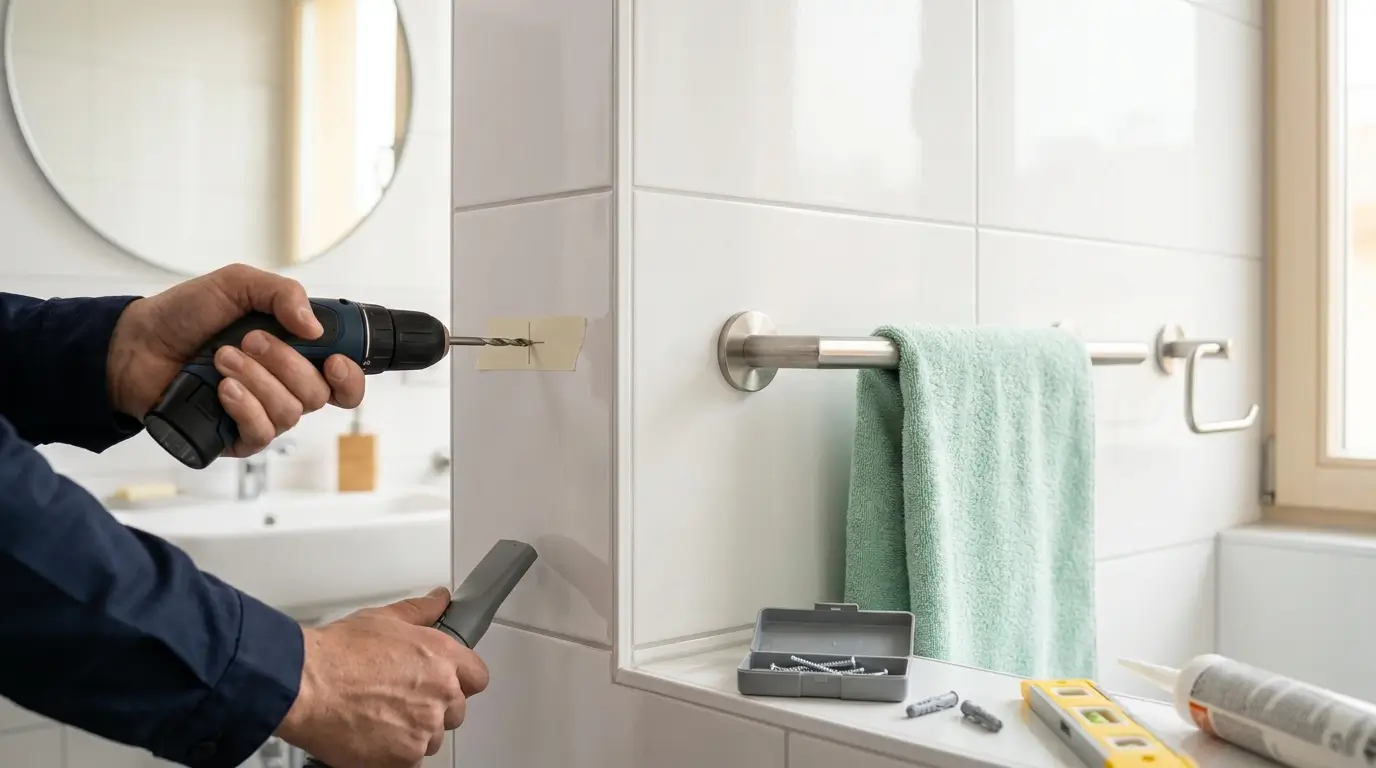
Before we drill, we scan the spot for electric cables and water pipes. We tap the wall and look at the first drill dust. Red means brick, grey concrete, white gypsum. Then we choose the plug.
2. The right plug for the wall
The kit in the box is usually a strap or a metal bracket plus the screws for the furniture. Plugs and screws for the wall are missing, because they depend on the wall. We bring those.
| Wall | What we use |
|---|---|
| Concrete, solid brick | universal 6 mm plug, for example the fischer DuoPower* |
| Perforated brick (brick with cavities inside) | a longer plug, drilled without hammer action so the thin walls inside the brick don't break |
| Altbau with thick plaster | plug and screw long enough to sit in the brick behind the plaster |
| Drywall | metal cavity anchor like the fischer HM*, for heavy wardrobes into the metal stud |
| Aerated concrete (Ytong) | a dedicated aerated concrete plug, drilled without hammer action |
In Viennese Altbau flats there is often a thick, crumbly layer of plaster in front of the brick. A short plug then only sits in the plaster and pulls out under load. Why that happens is in Drilling in Altbau: why the plug won't hold. The full overview by wall type is in Which wall plug for which wall?.
3. The right spot on the furniture
The bracket goes as high up on the piece as possible. The higher it sits, the less force it needs against tipping. We screw it into the top panel or a side panel. Never into the thin back panel. On most furniture it's only 3 mm thick and simply tears out under load.
On wide wardrobes we fit two brackets, left and right. Several frames side by side are first screwed to each other, then each one is anchored.
4. Fix it without twisting the piece
Hardly any furniture stands right against the wall. The skirting board holds it one to two centimetres away. Pull it to the wall with the anti-tip fixing and the frame twists. Then the doors no longer close cleanly.
So we level the piece first and bridge the gap to the wall. A strap stays slack enough. With a metal bracket we put a spacer behind it. Only then do we tighten the screws.
What often goes wrong with anti-tip fixings?
Most mistakes can't be seen from the front. They show once load comes onto the fixing.
| What you see | What it usually comes down to |
|---|---|
| The bag with the anti-tip kit is still in the box | not fitted, because the piece looks stable |
| The bracket is there, but the screw is loose in the wall | a plug for a different wall type, or only in the plaster |
| The bracket hangs off the back panel | screwed into the 3 mm board, which tears out |
| The doors no longer close since the piece was anchored | pulled to the wall, the frame has twisted |
| The bracket sits halfway up | mounted too low, too little leverage against tipping |
| After a move the piece stands loose | the fixing was removed on dismantling and never put back |
When we reassemble furniture after a move, we fit the anti-tip fixing again, matched to the new wall.
How to tell a good anchor
You can check these points on any piece of furniture yourself, whoever assembled it:
- The bracket sits at the top of the piece, in the top panel or a side panel.
- Nothing moves in the wall when you pull firmly at the top of the piece.
- The screw sits in the masonry, not just in the plaster.
- Wide wardrobes have two brackets.
- Doors and drawers run as well after anchoring as before.
- The spot was checked for cables and pipes before drilling.
What we don't do
- We don't leave a tall piece unanchored, not even "just for now" on request.
- Free-standing tall room dividers with no wall behind them we don't build up high. We suggest a lower version instead.
- We don't drill on a guess. If the scanner shows a cable, we find another spot.
- We don't anchor to radiators, window frames or pipes. Only to the wall.
How does it work with us?
Anchoring is included with every furniture assembly. Send us the product link, the model or a photo of the boxes via WhatsApp or email. A photo of the wall helps. You get a fixed price upfront, usually within an hour.
If you already have furniture without an anti-tip fixing, we secure it afterwards too. We bring plugs, screws and, if needed, suitable brackets.
| Service | Price |
|---|---|
| Shelf or bookcase assembly | from €60, anchoring included |
| Wardrobe assembly | from €79, anchoring included |
| IKEA PAX assembly | from €119, anchoring included |
| Securing existing furniture | from €60 per visit |
More on our furniture assembly in Vienna. How we build and secure a PAX step by step is in IKEA PAX assembly: 8 places where it goes wrong.
Frequently asked questions
Can furniture be secured against tipping without drilling?
There are adhesive and clamp solutions. For tall wardrobes, chests of drawers and anything in a children's room we don't rely on them. There, only a screw with a plug in the masonry counts. If an anti-tip kit is in the box, that's exactly what the manufacturer requires.
Why are there no wall plugs in the anti-tip kit?
Because the right plug depends on your wall. Concrete, solid brick, perforated brick, thick Altbau plaster and drywall each need something different. The manufacturer can't know which one you have. We check the wall on site and bring the right plug.
Can furniture be anchored to a drywall?
Yes. For an anti-tip fixing a metal cavity anchor that opens up behind the board is usually enough. For very tall, heavy wardrobes we also find the metal studs in the wall and screw into those.
Can I drill holes for an anti-tip fixing in a rented flat?
In Austria a few wall plug holes are generally part of normal use of a flat. If in doubt, check briefly with your landlord. When you move out, the holes can be filled cleanly.
What does it cost to secure furniture I already have?
For every piece we assemble, wall anchoring is included in the price. We secure existing furniture from €60 per visit, several pieces in one visit too.
In short
- Furniture tips when its centre of gravity moves past the front edge. Open drawers and a climbing child are enough.
- We anchor every tall wardrobe, bookcase, chest of drawers and loft bed.
- The plug depends on the wall; in Altbau it has to sit in the brick behind the plaster.
- The bracket goes at the top of the piece, never into the thin back panel.
- The piece is levelled, not pulled to the wall, so nothing twists.