The new towel rail has been in its box since you moved in. The bathroom is freshly tiled, and nobody wants to drill the first hole. What if the tile cracks?
That worry is fair. A broken tile in a finished bathroom is annoying. And a replacement from the same range is often no longer available. So gluing sounds tempting.
Sometimes gluing is right. Often it isn't. Here's how we decide in the bathroom: What do we glue, what do we drill, and how do we drill so the tile stays whole?
Glue or drill: how do we decide?
By two questions: Will it be pulled? And how heavy will it get? Light things nobody pulls on can be glued. Everything else we drill.
| Accessory | Our choice | Why |
|---|---|---|
| Small hook, soap dish, toothbrush holder | gluing is fine | light, hardly any pull |
| Toilet roll holder | drill | pulled every time it's used |
| Towel rail, towel ring | drill | wet towels are heavy and get pulled hard |
| Shower shelf, shower caddy | drill | full bottles, water, heat |
| Glass shelf | drill | heavy, and glass doesn't forgive a fall |
| Grab bar | always drill | someone leans their whole weight on it |
| Heated towel rail | drill | heavy, warm, cable or pipe behind it |
With adhesive, the rating on the pack is what counts. And it only applies to smooth, clean, dry tiles. On textured tiles, natural stone or across a grout line, adhesive holds a lot less. It also needs time. Load it too early and you lose part of the grip.
With a glued towel rail the pattern is almost always the same. It holds at first. After a few months of steam, heat and pulling, it comes off. Usually with the wet towel still on it.
What's behind the tile?
You can't see it from the outside. But it decides which plug will hold. Behind bathroom tiles there can be:
- solid brick or perforated brick (brick with cavities inside)
- concrete
- a cement board or moisture-resistant plasterboard, so a stud wall with a cavity behind it
In Vienna's old Gründerzeit buildings it's usually brick with plaster. In newer bathrooms it's often concrete or a stud wall. A plug made for solid walls won't hold in a cavity. It gives way as soon as someone pulls the towel off firmly. In stud walls we use cavity anchors, which open up behind the board. For a towel rail that gets pulled a lot, we find the metal studs in the wall and fix there.
This is how we find out what's behind the tile:
- Knocking: a dull sound means a solid wall. A hollow, bright sound means a board with a cavity, or a tile that is lying hollow (more on that below).
- Scanner: shows metal studs and warns of cables and pipes.
- Drill dust: once the bit is through the tile, the dust shows the wall. Red means brick, grey concrete, white gypsum.
How we pick the plug for every wall type is in our article Which wall plug for which wall?.
Grout line or tile: where do we drill?
Into the grout line, if the holder's holes line up with it. That spares the tile. And a hole in the grout is easier to close when you move out.
Usually it doesn't line up, though. Holders aren't made to match the grout lines. And a grout line is often only 2 to 3 millimetres wide. A 6 mm hole then chips the edges of the tiles on both sides. A clean hole in the middle of the tile is the better choice.
Before we drill, we hold the item against the wall and agree the height with you. As a guide: toilet roll holder about 60 to 70 cm above the floor, towel rail next to the basin about 100 to 120 cm. Only then do we mark.
Renting? Then check with your landlord before drilling into the tiles. If you still have spare tiles from when the bathroom was tiled, keep them. Many tile ranges are discontinued after a few years.
How do we drill through a tile without cracking it?
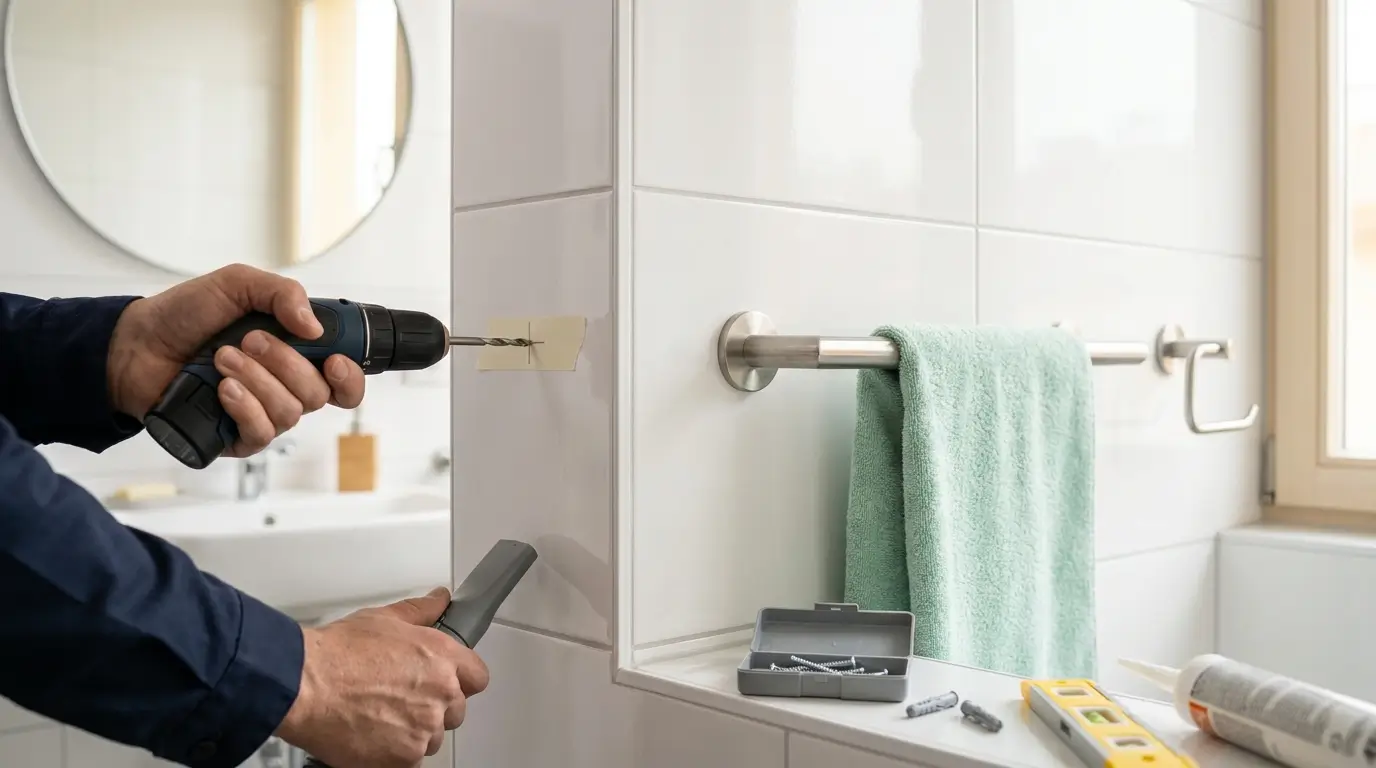
With a diamond bit, no hammer action, light pressure and cooling. Only once the tile is through do we switch to the bit for the wall behind it.
A tile is hard but brittle. With hammer action, the drill keeps hammering on the glaze, the hard top layer of the tile. That causes fine cracks. Sometimes they only run through the whole tile days later.
A diamond bit doesn't hammer. It grinds through slowly. Cooled with water, the spot stays cold and the tile isn't under stress. That's how we drill even porcelain stoneware, which is very hard, dense tile.
A few details you don't see from the outside:
- Masking tape on the mark, so the bit doesn't skate across the smooth glaze when we start.
- Starting slowly, at a slight angle, until the bit has cut a small notch. Only then straight and faster.
- Old tiles in period buildings sometimes have hairline cracks you can barely see. There we drill especially slowly.
- Vacuuming while drilling, so no drilling slurry runs into the grout.
Why do we set the plug deeper?
So it doesn't expand inside the tile. A plug holds because it spreads apart as the screw goes in. Set flush, it pushes from inside against the tile. That can burst it, even hours later.
So we set the plug deeper by the thickness of tile and adhesive. That's usually one to one and a half centimetres. We use a longer screw to match. Then the plug only expands where the wall actually carries the load.
What lasts in a damp bathroom?
Stainless steel screws and sealed holes. In a bathroom, heat and moisture change every day. The zinc-plated screws that come with many accessories rust over time.
- Stainless steel screws (A2, rust-free) instead of the ones in the box.
- Plastic plugs that don't rust, matched to the wall behind the tile.
- In the shower we seal every hole with silicone. Water behind the tile does more damage than the hole itself.
What do you see later if it was done wrong?
Most mistakes only show weeks or months after mounting. This is how you recognise them:
| What you see | What usually caused it |
|---|---|
| A fine crack running from the hole | drilled with hammer action, or the plug expands inside the tile |
| A brown stain under the holder | zinc-plated screws from the box |
| The holder wobbles or turns | the plug doesn't suit the wall |
| One morning the holder is on the floor | glued instead of drilled |
| A tile broke while drilling | it was lying hollow |
| The grout around a holder in the shower stays dark and damp | the hole wasn't sealed |
If an old holder wobbles, the hole has usually torn out. Then we take the holder off and fill the hole with injection mortar (mortar from a cartridge that sets hard in the hole). Then we set new plugs. The holder can usually stay in the same place.
How to recognise good work in the bathroom
Whoever drills in your home, you can check these points during the job:
- The wall is knocked and scanned for cables.
- The height is agreed with you before anything is marked.
- The tile is drilled with a diamond bit and no hammer action.
- The edges of the holes are clean, with no chipped glaze.
- Stainless steel screws go into the wall.
- Holes in the shower get sealed.
- The holder sits straight and doesn't move when you pull it hard.
What we don't do
- We don't drill into a tile that's lying hollow. We find another spot with you.
- We don't glue anything that gets pulled or that someone holds on to.
- The electrical connection of a heated towel rail is done by an external licensed electrician. We mount the rail on the wall.
- Water and heating connections are done by a plumber.
How does mounting work with us?
Message us on WhatsApp or by email with the items that should go on the wall. A photo of the items and the wall helps. You get the fixed price upfront. You buy the accessories. We bring plugs, stainless steel screws and the tools.
When buying, look for two things: stainless steel (rust-free) and a version made for drilling. For example a stainless steel towel rail*, a stainless steel toilet roll holder* or a stainless steel shower shelf*. For light things that don't get pulled, there are adhesive bathroom hooks*.
On site we check the wall, agree the heights with you, drill and mount. At the end we check together that everything is solid. We vacuum up dust and chips.
| Service | Price |
|---|---|
| Single accessory | from €35 |
| 3 to 5 items in one visit | from €79 |
| Heated towel rail (mounting only) | from €45 |
More on our bathroom accessory mounting in Vienna. Is there an old period wall behind the tiles? Then also read Drilling in old buildings: why the wall plug won't hold.
Frequently asked questions
Can you glue bathroom accessories to tiles instead of drilling?
For light things, yes: hooks, a soap dish, a toothbrush holder. The tile has to be smooth, clean and dry. Before the first load, the adhesive needs the full curing time on the pack. Anything that gets pulled or is heavy, we drill.
Do you drill into the grout line or the tile?
Into the grout line if the holder's holes line up with it. That spares the tile. Usually the hole spacing doesn't match the tile grid, though. Then we drill through the tile, with a diamond bit and no hammer action.
Will the tile crack when drilling?
With a diamond bit, no hammer action, light pressure and cooling, the risk is low, but never zero. Old tiles with fine cracks and tiles that sound hollow are more fragile. If we see a risk beforehand, we tell you.
What if a tile sounds hollow?
Then there's a gap in the tile adhesive behind it. Drill there and the tile can break, and the plug finds no grip. We put the holder on a tile that sounds solid, or find another solution with you.
How long does mounting bathroom accessories take?
A single item such as a toilet roll holder or hook takes about 20 to 30 minutes. Four to five items usually 60 to 90 minutes, depending on the wall and the number of holes.
In short
- Glue only light things that don't get pulled. Towel rails, toilet roll holders, shower shelves and grab bars get drilled.
- What's behind the tile decides the plug. So we knock and scan first.
- Drill with a diamond bit and no hammer action, and set the plug deeper than the tile.
- Use stainless steel screws and seal every hole in the shower.